AI Shopping Assistant vs Traditional Shopify Chatbot: What is the Difference?
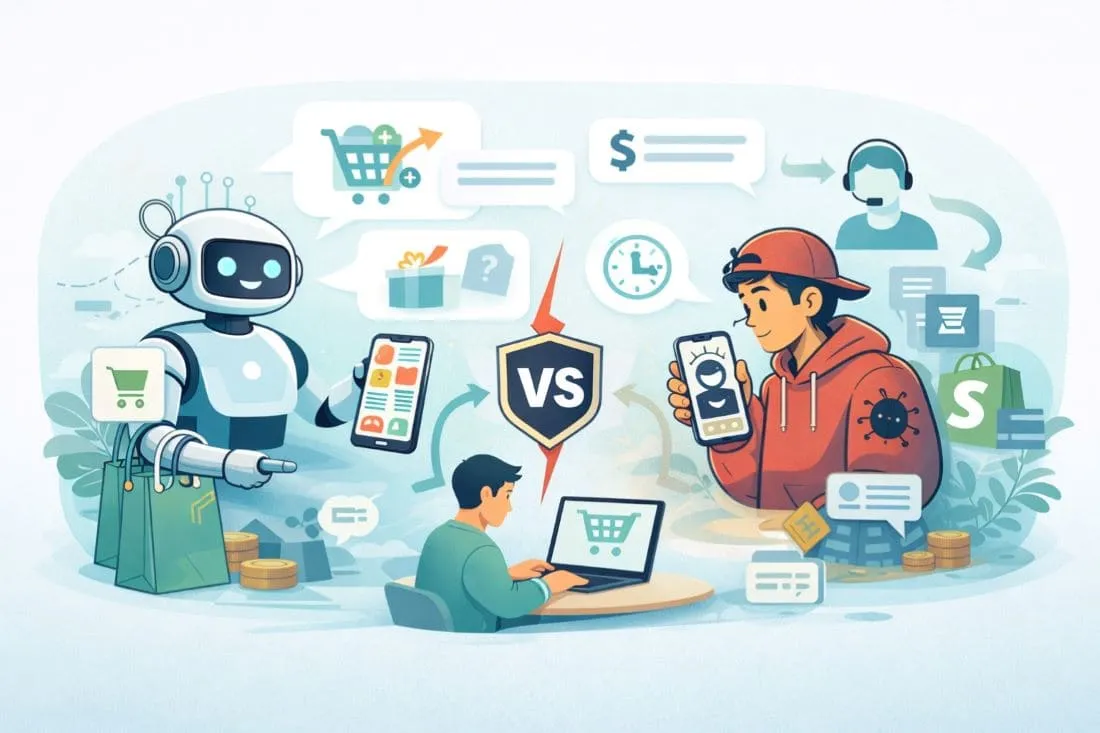
If you run a Shopify store, you have probably seen many tools described as chatbots, AI assistants, shopping assistants, live chat, and conversational commerce tools. These terms often get mixed together, but they are not the same thing.
A traditional Shopify chatbot is usually built to answer simple support questions. It follows rules, uses preset replies, and handles repetitive queries like shipping, returns, store hours, or order tracking.
An AI shopping assistant is much broader. It is designed to help customers discover products, compare options, ask follow up questions, get personalized recommendations, and in some cases move toward checkout. It acts more like a digital sales assistant than a basic support bot.
That difference matters because many merchants install a chatbot expecting it to increase sales, only to realize later that the tool mostly answers FAQ style questions and does very little to help a customer choose what to buy.
This article explains the difference in plain language, how each one works, where each one helps, where each one fails, and what Shopify merchants should pay attention to before choosing a solution.
The short answer
A traditional Shopify chatbot is mainly a support tool.
An AI shopping assistant is mainly a shopping and sales tool, though it can also support customers.
That is the simplest way to understand the difference.
A traditional chatbot usually says:
-
Here is our return policy
-
Your order is in transit
-
Shipping takes 3 to 5 business days
An AI-powered shopping assistant is more likely to say:
-
Based on what you want, these three products are the best fit
-
This one is better for dry skin, while this one is better for oily skin
-
If you want something under your budget, this is the better option
-
This product works with what you already have in your cart
That shift from answering fixed questions to guiding buying decisions is the biggest difference.
What is a traditional Shopify chatbot
A traditional Shopify chatbot is usually a scripted or rule based system placed on a Shopify store to handle common customer questions. It often relies on keyword matching, decision trees, or prebuilt FAQ flows.
It works well when the store already knows the common questions customers ask:
-
Where is my order
-
What is your return policy
-
Do you ship internationally
-
What are your support hours
-
How do I contact your team
For these tasks, a traditional chatbot can be useful. It saves support time and gives customers quick answers without waiting for a human agent.
The problem starts when the customer asks something less predictable:
-
Which version is best for my use case
-
I want a gift for someone who likes minimalist design and I only want to spend $70
-
What is the difference between these two products
-
Which option is better if I travel often
-
I need something similar to what I bought last time but in a smaller size
This is where many traditional chatbots struggle. They are not really built to think through shopping intent. They are built to route, retrieve, or reply within narrow boundaries.
What is an AI shopping assistant
An AI-powered shopping assistant is a more advanced conversational system that helps users shop through natural language. Instead of only replying to direct support questions, it tries to understand intent, use context, narrow choices, and recommend products.
It behaves less like a scripted support widget and more like a store associate.
A shopper can ask:
-
I need a lightweight rain jacket for a weekend trip
-
Which product is better for sensitive skin
-
Show me something similar but cheaper
-
I need a gift for my husband under $100
-
Compare these two items for me
A strong AI shopping assistant can:
-
understand what the customer means even if the wording is messy
-
ask clarifying questions
-
compare products
-
use product data and store context
-
personalize suggestions
-
keep the conversation going toward purchase
This is why Shopify is increasingly talking about AI personal shoppers, conversational product discovery, and agentic commerce rather than only chatbots.
Why this difference matters for Shopify stores
For many merchants, customer support is not the only problem. Product discovery is often the bigger one.
A customer may land on the site interested in buying, but not know:
-
which category to start with
-
which product fits their need
-
how one option differs from another
-
whether a product is compatible
-
whether the item is worth the price
-
whether it matches what they already have
If the store experience cannot answer those questions quickly, the customer leaves.
A traditional chatbot can reduce support load.
An AI shopping assistant can reduce support load and also help the customer move toward purchase.
That makes it far more valuable for stores where the buying decision is not obvious.
The core differences
1. Purpose
A traditional chatbot is usually designed for efficiency. Its goal is to answer repetitive questions and reduce support workload.
An AI shopping assistant is designed for guidance. Its goal is to help customers decide, discover, compare, and buy.
This is the first question every merchant should ask: Do I need a support bot, or do I need a sales assistant?
If your store mainly gets simple questions about shipping, returns, and order tracking, a traditional chatbot may be enough.
If your store depends on product education, comparison, recommendations, or discovery, you need something closer to an AI shopping assistant.
2. How they understand questions
A traditional chatbot often works through rules:
-
if customer says “return” show return policy
-
if customer says “order” ask for order number
-
if customer says “shipping” show shipping info
This works when the question is direct and predictable.
An AI shopping assistant uses language models and contextual reasoning. It does not rely only on a keyword. It tries to understand what the shopper is trying to do.
That means it can often handle questions like:
-
I need something for dry skin but not greasy
-
I want a backpack for short business trips
-
I do not know which model to choose
The assistant is interpreting intent, not just matching words.
3. Ability to ask follow up questions
A traditional chatbot often breaks if the flow changes.
An AI shopping assistant can continue the conversation:
-
Are you shopping for yourself or as a gift
-
What price range do you have in mind
-
Do you prefer lightweight or durable
-
Do you want fragrance free options
That ability is important because real shopping is not a one step query. It is usually a back and forth.
Human shoppers do not always start with a perfect search phrase. They start with partial intent. A good assistant helps shape that into a purchase decision.
4. Product discovery
This is where AI shopping assistants usually separate themselves most clearly.
A traditional chatbot may link to a collection page or show a help article.
An AI shopping assistant can narrow choices based on:
-
budget
-
intended use
-
size
-
style
-
preferences
-
past behavior
-
cart context
-
product attributes
That is much closer to how a helpful store associate works in a physical shop.
For many Shopify stores, product discovery is one of the biggest conversion bottlenecks. Customers are willing to buy, but they need help choosing.
5. Personalization
Traditional chatbots usually offer little or no personalization beyond basic flow logic.
AI-powered shopping assistants can work with richer signals such as:
-
products viewed
-
cart contents
-
previous purchases
-
current session behavior
-
store data
-
FAQ content
-
reviews
-
policies
-
customer account context where allowed
This does not mean every AI assistant will do all of this well. But this is the direction the technology is built for.
The point is not just answering a question. The point is giving a better answer for this customer in this moment.
6. Support vs sales impact
Traditional chatbots are usually strongest after the customer already has a specific need:
-
order status
-
return policy
-
contact support
-
shipping details
AI-powered shopping assistants are often strongest before the purchase:
-
what should I buy
-
which one fits me
-
what is the difference
-
what goes well together
-
which option is best for my needs
That is why an AI shopping assistant is often more closely tied to conversion improvement, while a traditional chatbot is more closely tied to support efficiency.
7. Data requirements
A traditional chatbot can work with limited content if the main flows are predefined.
An AI shopping assistant needs stronger data to perform well. It typically works best when the store has:
-
clear product titles
-
detailed descriptions
-
attributes like size, material, compatibility, ingredients, or dimensions
-
accurate pricing and availability
-
policies
-
FAQ content
-
review signals
-
structured store data
This is an important practical point.
Many merchants blame AI when results are weak, but the real issue is often poor source data. If product content is thin, vague, or inconsistent, the assistant will struggle.
AI does not replace product clarity. It depends on it.
8. Ability to take action
A traditional chatbot usually points users somewhere.
An AI powered shopping assistant may do more than talk. Depending on the setup, it may:
-
search the catalog
-
show matching items
-
compare products
-
reflect cart context
-
help add products to cart
-
assist with checkout flow
-
handle authenticated order lookups or account related requests
This is especially relevant with Shopify’s MCP based direction, where AI assistants can connect to real commerce data and actions rather than functioning as isolated chat widgets.
That changes the role of the assistant from “messaging layer” to “shopping layer.”
9. Flexibility
Traditional chatbots are easier to predict because the answers are usually predefined.
AI-powered shopping assistants are more flexible, but they also need stronger guardrails.
That means a merchant needs to think about:
-
what the assistant is allowed to answer
-
which sources it can use
-
when it should hand off to a human
-
how it should handle sensitive topics
-
how to avoid overconfident wrong answers
This is where implementation quality matters a lot.
A badly configured AI shopping assistant may sound smart but give weak or risky answers.
A well configured one can be extremely useful.
10. Maintenance
A traditional chatbot usually needs manual updates to rules and FAQ flows.
An AI shopping assistant also needs maintenance, but of a different kind:
-
improving source content
-
reviewing failed conversations
-
updating FAQs and policies
-
strengthening product data
-
refining prompts and boundaries
-
monitoring what shoppers ask most often
So while an AI shopping assistant can be more powerful, it is not really a set and forget system if you want high quality results.
A practical example
Imagine a skincare store.
A customer asks: “I have dry and sensitive skin and I want a simple routine under $80.”
A traditional chatbot may do one of these:
-
send the link to the skincare category
-
return a generic FAQ answer
-
fail because the query does not match a rule
An AI shopping assistant may do something much more useful:
-
ask whether the shopper wants a full routine or just one product
-
narrow recommendations based on budget
-
explain why a certain cleanser fits sensitive skin
-
recommend a moisturizer that matches the shopper’s stated need
-
point out fragrance free options
-
keep the total close to budget
Now imagine the same customer later asks: “Can I use this with the serum already in my cart?”
A traditional chatbot may not understand the question.
An AI shopping assistant with cart context can potentially give a much better answer.
That is the real difference in daily use.
GoodChatbot by Automatikly is one example of how this works in practice on Shopify. It is built to handle product comparison, cart context, follow-up questions, and order requests, the capabilities that separate a shopping assistant from a support bot. It has been developed after working with 1,000 stores and reports an 86% improvement in conversion.
Where traditional chatbots still make sense
Traditional chatbots are not useless. In some stores, they are still the right choice.
They make sense when:
-
the main goal is reducing repetitive support load
-
the customer questions are simple and predictable
-
the catalog is small
-
the products are easy to understand
-
the store does not need consultative selling
-
the merchant wants very strict control over every answer
-
the budget is limited and a simple support layer is enough
In those cases, a traditional chatbot can still be effective.
Not every store needs an AI shopping assistant on day one.
Where AI shopping assistants make the most sense
AI shopping assistants are especially useful when:
-
customers need help choosing among many options
-
products are technical, nuanced, or highly contextual
-
the average shopper needs education before buying
-
upsell and cross sell matter
-
product comparison is important
-
the store has rich product data
-
the store wants both support efficiency and conversion lift
-
the merchant is willing to improve data, training, and monitoring over time
These are common in categories like:
-
skincare and beauty
-
fashion and accessories
-
home and lifestyle
-
electronics and accessories
-
health related consumer products
-
specialty hobby products
-
furniture and decor
-
travel gear
-
gifts
In all of these, the customer often needs guidance, not just answers.
The role of Shopify in this shift
Shopify’s current direction makes this difference even more important.
Shopify is no longer framing AI only as a support add on. It is increasingly treating AI as part of how products are discovered, recommended, and bought. That includes:
-
AI personal shoppers
-
conversational commerce
-
AI discovery
-
knowledge sources for AI shopping agents
-
agentic storefronts
-
MCP based access to live commerce data
This matters because the future assistant on a Shopify store is not just answering FAQ questions in a chat bubble. It is becoming part of the buying journey itself.
That also means merchants should stop asking only: “Do I need a chatbot?”
A better question is: “Do I want a tool that answers support questions, or a tool that helps customers shop?”
The risks of calling everything “AI chatbot”
One of the biggest problems in this space is labeling.
Many tools are sold as AI chatbots, but they behave more like upgraded FAQ bots.
That creates confusion because merchants expect:
-
better product recommendations
-
product comparison
-
personalization
-
cart aware selling
-
higher conversion
-
richer conversations
But what they actually get is:
-
support automation
-
templated replies
-
narrow flows
-
simple keyword routing
That mismatch creates disappointment.
So when evaluating a tool, the merchant should not focus only on the label.
Instead, ask:
-
Can it compare products
-
Can it ask follow up questions
-
Can it use cart context
-
Can it personalize recommendations
-
Can it handle product discovery
-
Can it use real store data
-
Can it act on authenticated order requests
-
What happens when it does not know the answer
-
How is it monitored and improved
Those questions will tell you much more than the product category name.
SEO and GEO implications
This difference also matters for how your store appears in AI driven discovery.
Traditional chatbots usually work only on site. They help users already on your store.
AI shopping assistants are more connected to the broader direction of AI discovery. Shopify is pushing merchants to think about how AI systems understand products, policies, reviews, FAQs, and store facts.
That means your product content and knowledge structure are now part of both:
-
on site shopping assistance
-
off site AI discovery
This is where GEO and AEO come in.
If your product data is clear, your FAQs are strong, your policies are easy to interpret, and your store facts are well structured, AI systems are more likely to represent your brand correctly.
So even if your current priority is the assistant on your own store, the same content improvements can also help AI channels understand your products better.
How to choose the right one for your store
A simple way to decide is this:
Choose a traditional chatbot if:
-
your biggest issue is repetitive support questions
-
your products are simple
-
your customers rarely need guidance to decide
-
you want strict scripted behavior
-
you want a lighter implementation
Choose an AI shopping assistant if:
-
you want help with conversion, not just support
-
your customers need product guidance
-
product comparison matters
-
cross sell and upsell matter
-
you want a more consultative experience
-
you have or are willing to build stronger product and policy data
-
you want the assistant to reflect store context, cart context, and richer customer intent
For many serious Shopify stores, the better long term move is not replacing support with AI alone. It is combining support automation with shopping guidance.
That is the real promise of the AI shopping assistant model.
Final thoughts
A traditional Shopify chatbot and an AI shopping assistant may look similar on the surface because both live inside a chat interface.
But they solve different problems.
A traditional chatbot is mostly there to answer known questions.
An AI-powered shopping assistant is there to help customers decide what to buy.
That is why the second one is often much more relevant for conversion, product discovery, and the future of commerce on Shopify.
The practical takeaway is simple: Do not choose based on the label “AI chatbot.”
Choose based on the job you need done.
If you need fewer support tickets, a traditional chatbot may be enough.
If you need a tool that can guide, compare, personalize, and help customers move toward purchase, you are looking for an AI shopping assistant.
And for many Shopify merchants, that difference is no longer small. It is the difference between a help widget and a revenue tool. If you are ready to move from support automation to genuine shopping assistance, see what GoodChatbot by Automatikly offers.
Frequently Asked Questions
What is the main difference between an AI shopping assistant and a traditional Shopify chatbot?
A traditional Shopify chatbot mainly handles support style questions such as shipping, returns, and order status. An AI shopping assistant goes further by helping customers discover products, compare options, ask follow up questions, and move toward purchase.
Can a traditional Shopify chatbot still be useful for a store?
Yes. A traditional chatbot can still be useful if your main goal is reducing repetitive support questions and your products are simple enough that customers do not need much help choosing what to buy.
When should a store choose an AI shopping assistant instead?
A store should consider an AI shopping assistant when product discovery, product comparison, personalization, cross sell, and conversion improvement matter. It is especially useful when customers need guidance before buying.
Does an AI shopping assistant need better store data than a traditional chatbot?
Yes. An AI shopping assistant usually performs best when the store has clear product data, strong descriptions, detailed attributes, FAQ content, policies, and accurate pricing and availability information.
Can an AI shopping assistant also help with support questions?
Yes. A good AI shopping assistant can often handle both shopping guidance and support tasks. It can answer buying questions, compare products, explain policies, and in some cases assist with order related requests as well.
References