Volt Heat x goodChatBot: AI Powered Support Now Live
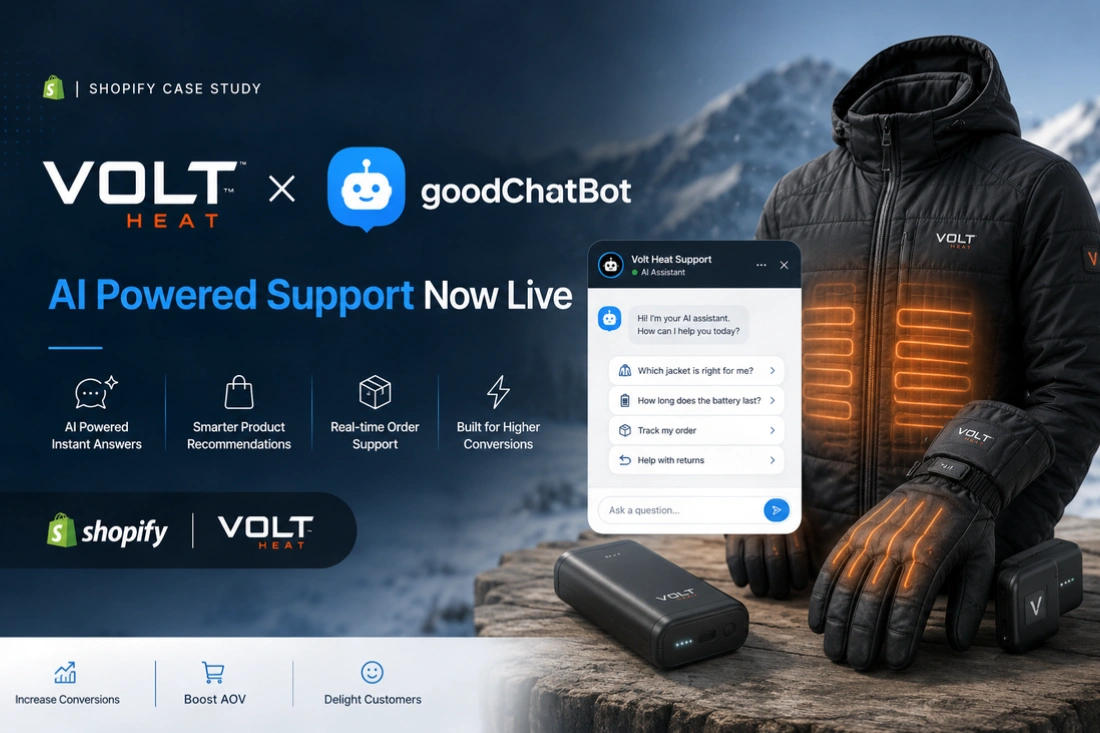
Volt Heat sells battery heated clothes for sub zero temperature. Customers often arrive with an immediate problem to solve. They need to know which battery works with a specific jacket, whether a replacement charger fits an old glove SKU, or how to store batteries during the warmer months without damaging them. When those answers are delayed, support volume rises and purchase momentum drops.
This case study shows how goodChatBot went live on Volt Heat's Shopify store and started handling those high intent questions in real time. The result was a much faster support experience, a lower need for human intervention, and a measurable lift in average order value during the off-season.
Why Volt Heat needed a more capable support layer
Volt Heat has spent years building a catalog around heated gloves, vests, socks, boots, slippers, and other cold weather gear. The challenge is that this is not a simple product category. The store carries multiple voltage systems, different batteries, different chargers, and products that require shoppers to understand compatibility before they can buy confidently.
That complexity is good for product depth but difficult for support. A shopper does not just ask whether a product is in stock. They ask whether a 5V or 7V system is required, whether a power bank will work, which charger replaces a lost accessory, how long a heated slipper lasts overnight, or how to store batteries through the summer. Before goodChatBot, those questions landed in support one by one.
First month results on Volt Heat
What makes this launch especially notable is the timing. Heated apparel is seasonal, and Volt Heat's first month with goodChatBot happened during the off-season. Traffic softens during spring and summer, purchase intent is less urgent, and every assisted conversion matters more.
-
20 percent increase in average order value during a period when overall sales were trending down year over year.
-
95 percent of 80 total conversations resolved without human intervention.
-
Only 4 conversations required a human to step in.
-
Average of 16 messages per conversation, showing that shoppers were getting guided through multi step decisions rather than receiving shallow one line answers.
For a store operating in a slow season, these numbers matter because they show the commercial value of answering technical questions at the exact moment a shopper is ready to act.
Before and after the launch
Before goodChatBot
Volt Heat's support burden came from the same pattern again and again. Customers were ready to buy or troubleshoot a product, but the answer they needed sat behind an email queue. A shopper with a heated jacket issue in freezing weather does not want to wait a day for a response. They want to know immediately whether the battery is compatible, which charger fits their SKU, or how to interpret a runtime or storage question.
Each delayed answer created two risks at once. It increased support backlog, and it increased the chance that a shopper would abandon the purchase or lose confidence in the product choice.
After goodChatBot
Once goodChatBot was trained on Volt Heat's catalog, FAQs, policies, and custom logic rules, those same questions started getting resolved inside the chat window. Instead of routing every technical query to support, the chatbot handled the majority of them instantly, accurately, and without escalation.
That changed both sides of the business. Support inbox pressure dropped, and shoppers got answers while they were still in buying mode.
How the chatbot worked in real conversations
FAQ integration for technical product questions
The FAQ integration gave goodChatBot direct access to Volt Heat's product knowledge, store specific policies, and recurring support information. This allowed it to handle both pre purchase and post purchase questions around product materials, battery care, runtime expectations, and compatibility.
Example: Zero Layer jacket power bank compatibility
A customer asked whether a Zero Layer jacket would work with a normal power bank or needed a special battery. goodChatBot explained that the answer depended on the voltage of the jacket. It clarified that 5V jackets can use a regular USB power bank, while 7V jackets require a proprietary 7V battery. When the customer shared the tag SKU, the chatbot identified the specific CRACOW 7V jacket and surfaced compatible 7V battery options with pricing and direct product links.
Example: Battery storage over the summer
Another shopper asked how to store 7V batteries through the off-season. goodChatBot gave a specific answer immediately: store them partially charged, keep them in a cool dry place, remove them from products, and top them up periodically during storage. No ticket was needed. The customer got a technically accurate answer in seconds.
Example: Product material breakdown
When a customer asked what the Polar X Heated Work Gloves were made from, goodChatBot returned a full material summary, including the outer shell, Kevlar threaded seams, fleece lining, insulation, waterproof membrane, and the placement of the Zero Layer heating elements. That is the kind of detailed product question generic chat tools often fail to handle well.
Built in capabilities beyond the FAQ layer
Volt Heat's setup did not stop at store FAQs. goodChatBot was also configured to handle complex catalog logic and multi turn assistance.
In one conversation, a customer asked for heated booties that could last through the night. goodChatBot compared runtime across three different products, noted which were in stock, recommended the in stock option most likely to fit the use case, and also helped with sizing based on shoe width.
In another conversation, a returning customer had lost the charger for a pair of heated leather work gloves and shared the product SKU. goodChatBot decoded the SKU, recognized the 7V requirement, showed compatible charger options, added the selected charger to cart, and completed an upsell when the shopper decided to add a car charger as well.
It also handled fast specification questions cleanly. When a shopper asked whether the Camo 7V Heated Hunting Vest had more than one heat setting, the chatbot confirmed that it had four adjustable settings and included the relevant battery and charger information without delay.
How goodChatBot was configured for Volt Heat
1) FAQ integration as the product knowledge base
The first layer of the setup connected goodChatBot to Volt Heat's product catalog, FAQ content, blogs, and policy material. This gave the chatbot a reliable source of truth for runtime comparisons, material specs, battery care, and product specific answers.
2) A custom logic layer for the hard cases
The second layer was a custom additional instructions framework designed for Volt Heat's technical catalog. This is what enabled goodChatBot to go beyond generic answers and reason through real support scenarios.
-
Voltage system logic that distinguishes among 5V, 7V, and 12V products, connector types, and matching accessories.
-
Battery troubleshooting workflows that guide the shopper through indicator checks, charger light behavior, and swap testing.
-
Compatibility matching that can identify the correct battery, charger, or accessory from a SKU, tag number, or product description.
-
Smart human handoff when the question exceeds the available store data, so the chatbot does not guess when certainty is not possible.
This last point is especially important. For a technical store, an inaccurate answer is worse than no answer. goodChatBot was configured to know when to help and when to escalate.
Why this matters for technical Shopify stores
Volt Heat is a strong example of the kind of store where AI support can create immediate value. The products are technical. Shoppers arrive with specific context. Compatibility questions influence conversion. Support cannot rely on slow response times when the customer is already mid decision.
In that environment, the difference between a sale and an abandonment can be one accurate answer delivered at the right moment. That is exactly where goodChatBot proved valuable for Volt Heat.
Final thoughts
Volt Heat's first month with goodChatBot showed that a well trained Shopify AI chatbot can do much more than deflect simple support tickets. It can resolve technical product questions, guide shoppers through compatibility decisions, recommend the right accessories, and support revenue even when the store is operating in its off-season.
For Volt Heat, that translated into a 95 percent self resolution rate and a 20 percent increase in average order value. Those are strong results, but the deeper takeaway is even more important: when a store sells complex products, real time product accurate support is not just a service function. It is part of the buying experience.
If your Shopify store sells products where specifications, compatibility, technical support, or configuration questions drive the purchase decision, this is exactly the kind of problem goodChatBot is built to solve.
Frequently asked questions
How much of Volt Heat's support volume did goodChatBot resolve without human help?
In its first month on the store, goodChatBot resolved 95 percent of 80 total conversations without human intervention. Only four conversations required a human to step in.
What business result stood out most during the off-season?
The clearest commercial outcome was a 20 percent increase in average order value during a period when overall year over year sales were trending down.
What kinds of questions did goodChatBot answer for Volt Heat?
It handled battery compatibility, charger matching, runtime guidance, battery storage advice, product material questions, and other multi step support and pre purchase conversations tied to heated apparel.
Why was a custom logic layer necessary for this store?
Volt Heat sells products across different voltage systems, battery types, and configurations. The custom logic layer helped the chatbot distinguish among those systems, match the right accessories, and escalate only when a human was truly needed.
Why is this case study relevant to other Shopify merchants?
It shows how an AI chatbot performs when the store sells technical products that require exact answers. Stores with complex specifications, compatibility questions, or multi step support needs can use the same model to reduce support load and improve conversion outcomes.