Conversational Commerce for Shopify Stores: A Beginner’s Guide
Introduction
Buying something online used to be a one-way street. A shopper visited your store, clicked around, maybe found what they needed, and either purchased or left. You had no idea who they were, why they left, or what would have made them stay.
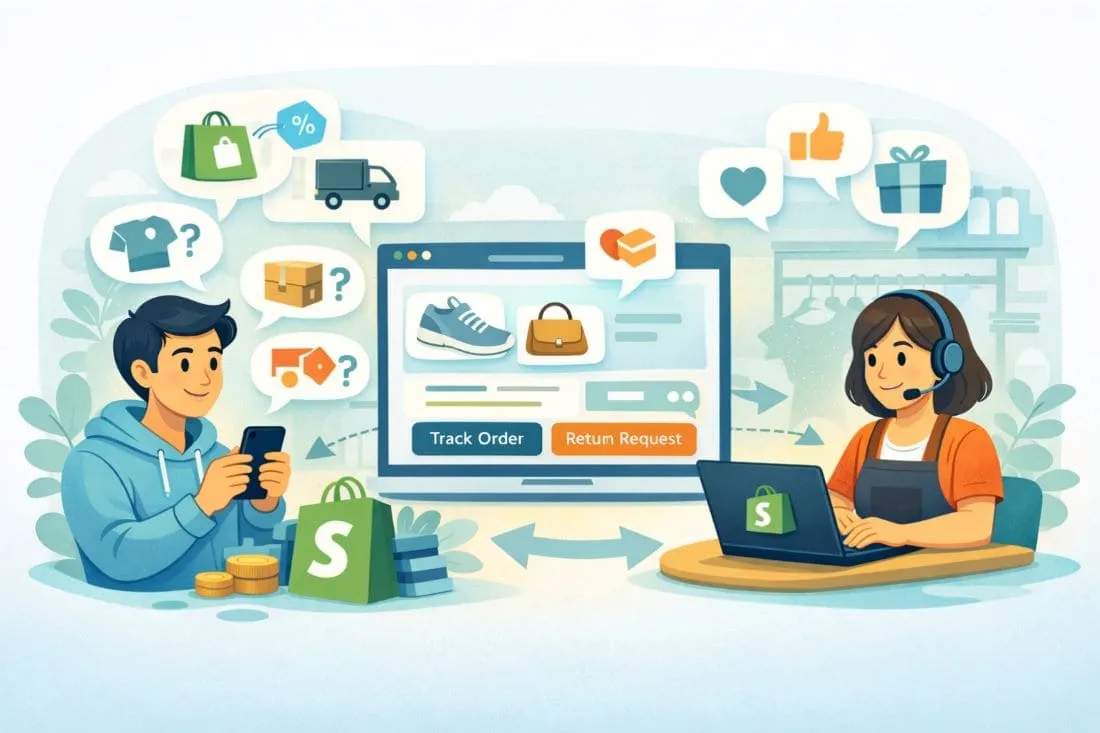
Conversational commerce for shopify changes that dynamic. It brings two-way communication into the shopping experience, so customers can ask questions, get recommendations, and complete purchases without ever leaving the conversation. For Shopify store owners, this is no longer an advanced feature reserved for enterprise brands. It is a practical, accessible set of tools that any store can implement, regardless of size or budget.
This guide explains what conversational commerce actually is, why it matters for Shopify specifically, which tools are available, and how to use them effectively to increase sales and reduce the friction that costs you customers every day.
What Is Conversational Commerce?
Conversational commerce is the use of messaging, chat, and voice interfaces to facilitate shopping. The term was coined by Uber product designer Chris Messina in a 2015 Medium post, where he described the shift from website-based commerce to interactions happening through messaging apps and chat interfaces.
The core idea is straightforward: instead of expecting customers to navigate a website, fill out forms, and figure out policies on their own, you meet them in a conversation. That conversation can happen through a chatbot on your website, a live chat with a human agent, a messaging app like WhatsApp or Facebook Messenger, an SMS thread, or even a voice assistant.
In practice, conversational commerce for Shopify store means:
-
A shopper lands on your product page and a chat window appears asking if they need help finding the right size.
-
A customer who abandoned their cart gets a WhatsApp message with a gentle reminder and a direct link back to checkout.
-
Someone messages your Instagram page asking whether a hoodie comes in forest green and gets an instant, accurate answer with a link to purchase.
-
A post-purchase chat follows up to confirm delivery and offer a discount on the next order.
None of these interactions require a customer to dig through your FAQ page or wait on hold. They are fast, contextual, and personal. That is what separates conversational commerce from traditional e-commerce.
Why Conversational Commerce Matters for Shopify Store Owners
Shopify has over 2 million active stores worldwide as of 2023, according to Shopify's own investor data. Competition is intense across almost every product category. The difference between stores that grow and those that stagnate often comes down to the customer experience, not the product.
Here is the problem most Shopify stores face: the average e-commerce conversion rate is between 1% and 4%, according to data from the Baymard Institute. That means 96 to 99 out of every 100 visitors leave without buying. A significant portion of those non-buyers had questions they never got answers to, concerns they could not resolve, or simply needed a nudge at the right moment.
Conversational commerce addresses these conversion killers directly. Research from Drift found that 82% of consumers want an immediate response when they have a question while shopping. A static FAQ page does not deliver that. A well-placed conversational commerce chatbot or automated message can.
Beyond conversion, there are three other reasons Shopify store owners pay attention to conversational commerce:
Repeat purchases. Acquiring a new customer costs five times more than retaining an existing one, according to research cited by Frederick Reichheld at Bain and Company. Post-purchase conversations that check in, offer support, and deliver relevant offers are among the most cost-effective ways to drive repeat orders.
Cart abandonment recovery. The global average cart abandonment rate is 70.19%, according to the Baymard Institute's research aggregating data from 49 studies. Conversational tools, particularly SMS and WhatsApp follow-ups, consistently outperform email for recovering abandoned carts because they are read faster and feel more personal.
Customer lifetime value. Shoppers who feel heard and supported buy more over time. A Harvard Business Review analysis found that customers who had the best past experiences spend 140% more than those who had the worst experiences. Conversation is the mechanism through which those positive experiences happen.
How Conversational Commerce Works on Shopify
Shopify's ecosystem makes it relatively straightforward to add conversational tools to your store. The platform integrates natively with some tools and supports hundreds of third-party apps through the Shopify App Store.
At a technical level, conversational commerce for Shopify involves four components working together:
The messaging interface. This is what the customer sees and types into. It could be a chat widget embedded in your storefront, a messaging app channel like WhatsApp Business, an SMS platform, or a social messaging integration with Instagram or Facebook Messenger.
The automation layer. This is the logic that determines what happens when a customer says or asks something. It includes chatbot flows, automated responses, keyword triggers, and AI-powered response generation. This is where tools like goodChatBot operate.
The data connection. For conversational commerce to be genuinely useful, the chat system needs to access your Shopify store data. This includes order status, inventory levels, product information, customer purchase history, and discount codes. Without this connection, a chatbot can only answer generic questions, not "where is my order?" or "do you still have this in size medium?"
The human handoff layer. Not every conversation can or should be handled by automation. Good conversational commerce systems include a seamless transition from bot to human agent when needed, with the full conversation context preserved so the customer does not have to repeat themselves.
When these four components work together, the result is a customer experience that feels responsive and personal, even when a human is not directly involved.
Types of Conversational Commerce Tools for Shopify
Understanding the different tools available helps you choose the right approach for your store's goals, customer base, and team capacity.
Website Chat Widgets
A chat widget is the most familiar form of conversational commerce. It is the small chat bubble that appears in the corner of your website. When clicked, it opens a conversation interface.
Chat widgets can be powered by live agents, automation, or a combination. For Shopify stores with limited staff, the most practical approach is a conversational commerce chatbot that handles common questions (order tracking, returns policy, sizing information, product availability) with an option to escalate to a live agent during business hours.
Shopify Inbox, discussed in detail below, is Shopify's native solution for website chat. Third-party options include goodChatBot, and Zendesk.
Live Chat with Human Agents
Live chat involves real people responding to customers in real time. It has the highest customer satisfaction ratings of any support channel, with Econsultancy research finding 73% satisfaction rates for live chat compared to 61% for email and 44% for phone.
The challenge for small Shopify stores is staffing. Live chat requires agents available during peak hours, which is not always feasible for solo operators or small teams. A common approach is to offer live chat during defined hours and use automated responses outside those windows to set expectations and capture contact information for follow-up.
Chatbots and AI-Powered Assistants
Chatbots range from simple rule-based tools that follow a decision tree to sophisticated AI-powered assistants that understand natural language, pull live Shopify data, and generate contextual responses. The most effective implementations sit at the intersection of both; this is where AI conversational commerce earns its name, moving beyond scripted menus to handle intent, context, and nuance in real time.
For most Shopify stores, the practical entry point is a hybrid: a chatbot handles predictable, high-volume questions automatically, while an AI layer makes the interactions feel more natural than a rigid menu system. The most common chatbot use cases in Shopify are order tracking, FAQ answering, product recommendation, and cart abandonment prompting.
SMS Messaging
SMS has open rates of around 98% and response rates that are significantly higher than email, according to research published by SimpleTexting and EZTexting. For Shopify stores, SMS is primarily used for order confirmations, shipping updates, abandoned cart recovery, and promotional campaigns.
Tools like Klaviyo, Postscript, and Attentive integrate directly with Shopify and support two-way SMS conversations, not just one-way blasts. A customer who receives an SMS about their order and replies with a question can get an automated or human response in the same thread.
WhatsApp Business
WhatsApp has over 2 billion active users globally, according to Meta's 2023 earnings data. In markets outside the United States, including India, Brazil, Germany, and most of Southeast Asia, WhatsApp is the primary digital communication channel for a large share of the population.
For Shopify stores selling internationally, WhatsApp Business integration is not optional. It is where your customers expect to communicate. The WhatsApp Business API integrates with Shopify through tools like Zoko, WATI, and Charles, enabling order notifications, cart recovery, and two-way customer support directly in WhatsApp.
Facebook Messenger and Instagram DMs
Meta's messaging platforms are deeply integrated with social commerce. Instagram Shopping and Facebook Shops allow products to be discovered and purchased within the apps. When customers ask questions in DMs or comments, those conversations need to be managed efficiently.
Voice Commerce
Voice is the least mature channel in this list for Shopify stores. Smart speaker commerce through Amazon Alexa and Google Assistant has grown more slowly than predicted, largely because the interface is not ideal for browsing and discovery. However, voice search is increasingly influencing how customers find products, even if they complete the purchase on a screen. Optimizing product descriptions and FAQ content for voice query phrasing is a practical first step even without a dedicated voice commerce integration.
Shopify Inbox: The Built-In Starting Point
Shopify Inbox is Shopify's native live chat and messaging tool, available free to all Shopify merchants.
Merchants use it for the manual replies to customer enquiries.
Shopify reports that stores using Shopify Inbox convert 69% more sessions where a chat occurs into purchases compared to sessions without chat. That statistic speaks directly to the revenue impact of simply being available for conversation.
The limitations are worth acknowledging; it is not a full-featured conversational commerce platform. It is not a full-featured chatbot platform. The automation capabilities are basic. It does not natively support SMS or WhatsApp. And it lacks the analytics depth of purpose-built customer service platforms. For stores just starting with conversational commerce, it is an excellent free foundation. As your volume grows, you will likely want to augment it with a more capable third-party tool.
goodChatBot : The Automated AI Chat Bot Assistant for Shopify
goodChatBot is an AI chatbot built for Shopify stores to improve customer experience and support store growth. It helps shoppers get quick answers about products, policies, shipping, returns, and other common questions without waiting for a human agent. By giving instant and relevant responses, goodChatBot helps reduce drop-offs, improves engagement, and support customers throughout their buying journey.
What makes goodChatBot different from a generic conversational commerce chatbot is that it is designed around your store, not as a one-size-fits-all chatbot. It can be customized based on your products, policies, FAQs, and customer behavior, so the answers feel more accurate and useful. This creates a more personalized shopping experience and helps customers feel confident while browsing and making purchase decisions.
goodChatBot also helps store owners reduce support load while staying available around the clock. It can handle repetitive questions, guide users to the right products, and support sales as well as customer service. The result is a smarter Shopify chatbot that saves time for your team, improves customer satisfaction, and helps increase conversions.
Key Use Cases: Where Conversational Commerce Delivers Results
Knowing the tools is only part of the picture. Understanding where and how to use them makes the difference between a chatbot that sits unused and one that actively drives revenue.
Product Discovery and Recommendations
Many shoppers know what they want but struggle to find it. A conversational tool that helps customers navigate your catalog, filter by their needs, and land on the right product reduces the time to purchase and increases satisfaction.
A furniture store might deploy a chat quiz that asks about room size, style preference, and budget before recommending specific pieces. A skincare brand might ask about skin type and concerns before suggesting a routine. A running shoe store might ask about terrain, gait, and experience level before surfacing the right options.
This kind of guided selling is what a great in-store sales associate does naturally. AI conversational commerce replicates it at scale, online, around the clock.
Abandoned Cart Recovery
Cart abandonment is the single largest revenue leak in e-commerce . A shopper who has already added items to their cart has demonstrated strong purchase intent. The right message at the right moment can close that sale.
Conversational cart recovery outperforms email in most studies because of speed and format. An SMS or WhatsApp message sent 30 to 60 minutes after abandonment is read almost immediately. A conversational format that acknowledges the specific items in the cart feels personal rather than automated.
Research from Klaviyo found that abandoned cart SMS flows generated 33 times more revenue per message than promotional SMS. The difference is relevance: the customer already wanted those items.
Order Tracking and Post-Purchase Support
"Where is my order?" is the most common customer service question in e-commerce. A conversational commerce chatbot connected to your shipping carrier data costs almost nothing and delights customers.
A chatbot that can retrieve order status, provide tracking links, and explain delivery timeframes handles this question without human involvement. When issues arise (delays, missing packages, wrong items), the bot can triage and escalate appropriately.
Post-purchase conversations also include review requests, upsell and cross-sell messages, and loyalty program enrollment. A customer who just received their order and is feeling good about it is the ideal recipient for a request to share feedback or try a complementary product.
Returns and Exchanges
Returns are a source of anxiety for both customers and store owners. Customers worry about whether the process will be easy. Store owners worry about the cost and the volume.
A conversational returns flow reduces both problems. The customer starts a return by messaging your chat widget or sending a WhatsApp message. The bot confirms eligibility, explains the process, generates a return label, and sets expectations for refund timing. The customer completes the return with less friction. The store reduces agent time spent on return processing.
Lead Capture and List Building
Every visitor who leaves your Shopify store without buying and without leaving any contact information is gone. You have no way to reach them again. Conversational tools change this.
A chat widget that opens with "Want 10% off your first order? Drop your email here" converts some percentage of first-time visitors into contacts you can market to later. A quiz that captures an email address to send personalized product recommendations builds your list while delivering value.
Customer Feedback and Reviews
Generating reviews is one of the highest-leverage activities for a Shopify store because reviews drive organic conversion. A product with 50 reviews converts significantly better than one with 5.
A post-purchase SMS or chat message sent a week after delivery, asking a simple question about the experience, generates response rates that email cannot match. If the response is positive, the follow-up nudges toward a review. If it is negative, the follow-up routes to a support flow so the issue can be resolved before it becomes a public complaint.
Setting Up Conversational Commerce on Your Shopify Store: A Step by Step Approach
If you are starting from scratch, this is a practical sequence that builds toward a full conversational commerce setup without overwhelming your team or budget.
Step 1: Enable Shopify Inbox
Before investing in any third-party tool, activate Shopify Inbox. It is free, already connected to your store, and takes about 15 minutes to configure. Set up your automated away message, add quick replies for your most common questions (order status, return policy, shipping times), and connect your Facebook page and Instagram if relevant.
Use Shopify Inbox for your first 30 to 60 days of conversational commerce. This gives you real data on what customers are asking, which is invaluable when you eventually build more sophisticated automations.
Step 2: Identify Your Top Five Customer Questions
Look at your support inbox, your FAQ page traffic, and your Shopify Inbox conversations. Identify the five questions customers ask most frequently. These are the highest-value targets for automation because answering them automatically saves the most time.
For most Shopify stores, the top five include some combination of: where is my order, what is your return policy, do you ship internationally, what size should I order, and is this item in stock.
Step 3: Build Automated Responses for Those Questions
Using Shopify Inbox's saved replies feature, or a third-party tool if you have chosen one, create accurate, helpful automated responses for your top five questions. Connect order tracking to live carrier data where possible. Link to your sizing guide, returns page, or shipping policy page.
Do not try to automate everything at once. Start with these five, measure accuracy and customer satisfaction, and expand from there.
Step 4: Set Up an Abandoned Cart Flow
This is often the highest immediate revenue impact step in conversational commerce. Use Shopify’s Flow to create a three-part abandoned cart sequence: a first message 30 to 60 minutes after abandonment, a second message 24 hours later with a small incentive, and a final message 48 to 72 hours later as a last chance.
Keep the messages short and conversational. Use the customer's name and reference the specific items in their cart. Make it easy to reply with a question or complete the purchase with one tap.
Step 5: Choose a Multi-Channel Tool If Needed
If your customers are reaching you across multiple channels (website chat, Instagram DMs, Facebook Messenger, email) and managing them separately is becoming unmanageable, this is the point to consolidate into a dedicated conversational commerce platform that unifies those conversations in one inbox.
The primary benefit is efficiency: agents respond faster when they do not switch between tabs, and customers get consistent service regardless of the channel they used to reach you.
Step 6: Add Behavioral Chat Triggers
Once your basic setup is running, add proactive triggers that start conversations based on visitor behavior. Common triggers worth implementing for Shopify stores include:
-
A message that appears when a visitor has been on a product page for more than 45 seconds without adding to cart.
-
A message that appears when a visitor has items in their cart and appears to be idle.
-
A welcome message for returning customers that references their previous purchase.
-
A post-purchase check-in message 7 to 10 days after delivery.
These triggers turn your chat from a reactive tool (the customer reaches out) into a proactive one (you reach out at the right moment).
Step 7: Measure, Iterate, and Expand
Conversational commerce is not a set-and-forget system. Track the metrics that matter: chat-to-purchase conversion rate, average response time, chatbot containment rate (how many conversations resolved without human escalation), cart recovery rate, and customer satisfaction scores.
Use this data to identify where the gaps are. If many customers are asking questions your bot is not handling well, improve the automation. If certain trigger messages are generating conversations but not conversions, adjust the timing or the message. Treat your conversational commerce setup as a product that you continuously improve.
Step 8: Customize your ChatBot
Use a solution like goodChatBot to fully personalize your AI conversational commerce setup for your store, connecting Shopify app data, internal systems, and external tools while tailoring workflows to match your exact business needs.
You stay in full control of how the chatbot communicates and responds. This not only saves time for your team but also helps deliver a stronger brand experience and builds better trust and reputation with your customers.
Measuring Conversational Commerce Performance
Knowing which numbers to track is as important as setting up the tools. Here are the key performance indicators (KPIs) for a Shopify conversational commerce program.
Chat-to-Purchase Conversion Rate
This measures the percentage of sessions where a chat interaction occurred that ended in a purchase. A rate higher than your overall store conversion rate confirms that conversation creates value. A rate lower than your store average suggests the chat experience needs improvement.
Abandoned Cart Recovery Rate
Of the customers who received an abandoned cart message, what percentage completed their purchase? Track this by channel (SMS vs email vs WhatsApp) to identify which performs best for your audience.
First Response Time
How long does a customer wait before receiving a first reply to their message? For live chat, best practice is under 2 minutes during staffed hours. For automation, the response should be near instant. Long first response times are the primary driver of negative chat experiences.
Resolution Time
How long does it take from the first message to the conversation being resolved? Short resolution times indicate effective automation and well-trained agents. Long resolution times often point to knowledge gaps in the bot or insufficient agent staffing.
Customer Satisfaction Score (CSAT)
After each resolved conversation, send a one-question satisfaction survey. A simple thumbs up/thumbs down or 1 to 5 star rating collected consistently gives you a reliable measure of chat quality over time.
Common Mistakes Shopify Stores Make with Conversational Commerce
Understanding where stores go wrong helps you avoid the same path.
Using a Chatbot That Cannot Access Store Data
A chatbot that cannot look up orders, inventory, or customer history is a chatbot that frustrates customers. When someone asks "where is my order?" and the bot says "please contact us at support@yourstore.com," it has failed. Before launching any chatbot, confirm it has live access to the data it needs to answer your most common questions.
Overcomplicating the Bot Flow
Many store owners build elaborate decision trees with dozens of branches. Customers get lost, confused, or frustrated navigating them. The most effective chatbot flows are short, direct, and clear.
Ignoring Mobile
More than 70% of Shopify traffic comes from mobile devices, according to Shopify's own data. Chat widgets that look fine on desktop but overlap content, cover checkout buttons, or are hard to tap on mobile create a worse experience than no chat at all. Test every conversational touchpoint on mobile before going live.
Not Connecting Chat to Your Marketing Stack
Conversations generate valuable data: questions customers ask, objections they raise, products they inquire about. If this data lives in a silo, disconnected from your Shopify CRM, email platform, or advertising system, you are missing the chance to use it. Set up integrations so chat data enriches your customer profiles and informs your marketing.
Treating Automation as the Entire Solution
Automation handles scale. Human agents handle relationships. The most successful Shopify stores use automation to handle the volume and humans to handle the moments that matter: complaints, complex questions, high-value orders, and unhappy customers. A chatbot that refuses to escalate, or that makes escalation difficult, is one of the fastest ways to damage customer trust.
Sending Too Many Messages
Conversational commerce depends on permission and trust. SMS and WhatsApp especially are personal channels. Sending too many messages, or messages that are not relevant, burns subscriber lists quickly. Start conservative with message frequency, monitor unsubscribe rates, and let engagement data guide how often you reach out.
Conversational Commerce and SEO: What Shopify Store Owners Should Know
Conversational commerce does not directly affect your Shopify store's search rankings, but it influences several factors that do.
Dwell time and bounce rate. A visitor who engages in a conversation spends more time on your site and is less likely to bounce immediately. These behavioral signals matter to Google's ranking algorithms. Stores that introduce chat and see increased engagement often see modest improvements in organic performance over time.
Review volume. Conversational post-purchase flows that solicit reviews increase the number of reviews your products accumulate. More reviews mean richer structured data, better star ratings in search results, and improved click-through rates from Google Shopping listings.
FAQ content generation. The questions customers ask in chat conversations are a direct signal of what people want to know about your products and store. Using these questions to build out FAQ schema markup on your product pages and help center creates content that targets long-tail search queries your customers are actually using.
Reduced return and churn rates. Customers who get their questions answered at the right moment are less likely to return products, dispute charges, or leave negative reviews. These operational improvements have a compounding effect on your store's reputation, both with customers and with Shopify's algorithm for featured placement.
Conversational Commerce and GEO: Showing Up in AI-Generated Answers
Generative engine optimization (GEO) is the practice of making your content discoverable and citable in AI-generated answers from tools like ChatGPT, Google's AI Overviews, and Perplexity. As more shoppers begin their buying journey with a question to an AI rather than a Google search, being represented in those answers matters.
For a Shopify store, GEO applies at two levels:
Brand level. If someone asks an AI tool "what are good Shopify apps for live chat?" or "how do Shopify stores handle order tracking via chatbot?", being mentioned in published content, reviews, case studies, and third-party directories that AI systems index increases the chance your store or tool gets cited when someone asks an AI tool about conversational commerce platforms for Shopify.
Content level. Publishing clear, factual, well-structured content about your products, policies, and expertise signals to AI systems that your site is a reliable source. Blog posts that directly answer specific questions, help articles with clear headings and concrete information, and FAQ pages with complete answers all contribute to this.
The most direct GEO tactic for Shopify stores is to publish content that directly answers the questions your customers are asking in chat. This creates a feedback loop: conversations reveal questions, questions become content, content surfaces in AI-generated answers, AI-generated answers bring new customers to your store.
Real-World Examples of Conversational Commerce in Action
Direct to Consumer Skincare
A mid-size Shopify skincare brand implemented a chatbot quiz on its homepage that asked five questions about skin type, concerns, and routine preferences. The quiz recommended a three-product bundle and offered a 15% discount for completing it. The brand reported a 22% increase in average order value among customers who completed the quiz compared to those who browsed the catalog directly.
Independent Apparel Retailer
A small clothing store with two employees set up Shopify Inbox with automated responses for sizing and returns questions, and a Klaviyo SMS flow for abandoned carts. Within 90 days, the SMS abandoned cart flow alone recovered approximately $4,200 in otherwise lost revenue, according to the store owner's published case study on the Klaviyo blog.
Specialty Food Brand
A gourmet food brand selling on Shopify used WhatsApp Business to send order confirmations and delivery updates to customers in the UK and Europe. They added a post-delivery message asking for feedback and offering a recipe suggestion using the purchased product. Open rates on WhatsApp messages exceeded 90%, and the reply rate to the feedback request was 28%, compared to 3% for the same campaign run via email.
The Future of Conversational Commerce on Shopify
The direction is clear: conversation is becoming a standard part of the e-commerce experience rather than a premium add-on. Generative AI within chat is moving from enterprise tools to SMB-accessible platforms, and AI conversational commerce tools like goodChatBot are bringing this capability to stores of every size. Several developments are shaping what that looks like for Shopify stores over the next few years.
-
Generative AI within chat. AI that generates contextually appropriate, personalized responses in real time is moving from enterprise tools to SMB accessible platforms. goodChatBot and similar tools are bringing this capability to stores of every size. Within two to three years, most Shopify chatbots will be generative rather than rule-based.
-
Conversational checkout. The ability to complete a purchase without leaving a messaging thread is expanding. WhatsApp Pay is available in India and Brazil, and Meta is expanding it. Shopify's checkout integrations are deepening. A customer will increasingly be able to discover, discuss, and purchase a product in a single WhatsApp or Messenger conversation.
-
AI-powered personalization at scale. Conversational tools connected to rich customer data will be able to deliver product recommendations, pricing, and messaging personalized to individual purchase history, browsing behavior, and stated preferences. This is already available at the enterprise level and is working its way down to mid-market and SMB tools.
-
Voice search optimization. As smart speakers and AI voice assistants become more capable, the query patterns of voice searches will increasingly intersect with product discovery. Shopify stores that optimize their content for conversational query formats will be better positioned to capture this traffic.
-
Tighter social commerce integration. TikTok Shop, Instagram Shopping, and YouTube Shopping are growing rapidly. As purchasing directly within social platforms becomes more common, the conversation layer between discovery and checkout shrinks. Stores with strong conversational commerce infrastructure will be better positioned to convert social traffic efficiently.
Conclusion
Conversational commerce is not a complicated concept. It is the idea that shopping should feel like a conversation, not a form-filling exercise. For Shopify store owners, it is one of the most practical ways to increase conversion rates, recover lost revenue from abandoned carts, and build customer relationships that generate repeat purchases over time.
The entry point is low. Shopify Inbox is free. SMS tools are available at a low monthly cost. The ROI on even a basic abandoned cart flow is measurable within weeks. And as your needs grow, more channels, more complex questions, more catalog depth, a purpose-built conversational commerce platform like goodChatBot gives you the depth to match.
goodChatBot is built specifically for Shopify stores that have outgrown generic tools. It handles order questions, returns, and FAQs with live store data behind every answer — fine-tuned around your products, your tone, and your customers. The ceiling is also high. As AI improves, conversational commerce for Shopify will increasingly power the entire customer journey, from first product discovery through to repurchase, automatically, across every channel your customers use.
Starting now, even simply, puts you ahead of the majority of Shopify stores that still rely entirely on static pages, unanswered messages, and hope that customers will find what they need on their own. And when you are ready to go further, goodChatBot has a plan for stores at every stage. See which one fits yours →
Frequently Asked Questions
What is conversational commerce on Shopify?
Conversational commerce on Shopify is the use of chat, messaging, SMS, social messaging, and AI assistants to help customers ask questions, discover products, recover carts, get support, and complete purchases through a conversation.
Is Shopify Inbox enough to get started?
Yes. Shopify Inbox is a strong starting point for many stores because it is free, easy to activate, and already connected to the Shopify storefront. As your volume grows, you may want to add more advanced conversational commerce platform or multi-channel tools.
What are the best use cases for conversational commerce?
The strongest use cases are product discovery, order tracking, abandoned cart recovery, returns support, post-purchase follow-up, and lead capture.
Does conversational commerce improve conversion rates?
It often does because it removes friction at the moment a shopper has a question or hesitates. Faster answers, personalized recommendations, and timely cart recovery messages can all improve conversion performance.
Should I use live chat or AI chatbots?
Most Shopify stores benefit from a hybrid model. Use a conversational commerce chatbot for common questions and high-volume tasks, then hand complex or high-value conversations to a human agent.
Which channels matter most for Shopify stores?
That depends on your audience, but website chat, SMS, Instagram DMs, Facebook Messenger, and WhatsApp are the most common conversational commerce channels for Shopify merchants.
How do I measure conversational commerce performance?
Track chat to purchase conversion rate, abandoned cart recovery rate, first response time, resolution time, customer satisfaction, and how many conversations are resolved without human escalation.
Can conversational commerce help with SEO and GEO?
Yes. Conversations reveal the real questions customers ask. Those questions can be turned into better FAQ content, blog posts, and help pages that improve search visibility and make your content easier for AI systems to understand and cite.
References
-
Messina, C. (2015). 2016 Will Be the Year of Conversational Commerce. Medium.
-
Shopify Inc. (2023). Shopify Annual Report 2023: Merchant and Platform Data. Shopify Investor Relations.
-
Baymard Institute. (2023). 44 Cart Abandonment Rate Statistics. Baymard Institute Research Library.
-
Baymard Institute. (2023). Average Ecommerce Conversion Rate Benchmarks. Baymard Institute Research Library.
-
Drift. (2022). The State of Conversational Marketing Report. Drift.com Inc.
-
Reichheld, F., & Schefter, P. (2000). E-Loyalty: Your Secret Weapon on the Web. Harvard Business Review, 78(4), 105-113.
-
Dixon, M., Freeman, K., & Toman, N. (2010). Stop Trying to Delight Your Customers. Harvard Business Review.
-
Econsultancy. (2022). Multichannel Customer Service: Benchmark Report. Econsultancy Ltd.
-
SimpleTexting. (2023). SMS Marketing Statistics Report. SimpleTexting.com.
-
Meta Platforms Inc. (2023). Q4 2023 Earnings Report: WhatsApp User Data. Meta Investor Relations.
-
Shopify Inc. (2023). Shopify Inbox: Merchant Performance Data. Shopify Help Center Documentation.
-
Klaviyo. (2022). SMS Benchmark Report: Revenue per Message by Flow Type. Klaviyo Inc.
-
Postscript. (2023). SMS for Ecommerce: Abandoned Cart Performance Benchmarks. Postscript Inc.
-
Shopify Inc. (2023). Shopify Mobile Commerce Report: Traffic and Conversion by Device. Shopify Inc.
-
Google. (2023). Search Quality Evaluator Guidelines: Page Experience Signals. Google Search Central Documentation.
-
Loop Returns. (2022). Returns Experience Report: Consumer Attitudes and Brand Loyalty. Loop Returns Inc.
-
Forsey, C. (2023). The Ultimate Guide to Conversational Marketing. HubSpot Marketing Blog.
-
Klaviyo. (2023). Case Study: How a DTC Apparel Brand Recovered $4,200 in 90 Days with SMS Flows. Klaviyo Customer Stories.
-
Harvard Business Review Analytic Services. (2014). The Value of Customer Experience, Quantified. Harvard Business Review.
-
EZTexting. (2023). Business Texting and SMS Marketing Report. EZTexting Inc.
-
Shopify Inc. (2022). Commerce Trends 2023: The Future of Retail. Shopify Inc.