What is a Shopify AI Chatbot and How Does It Work?
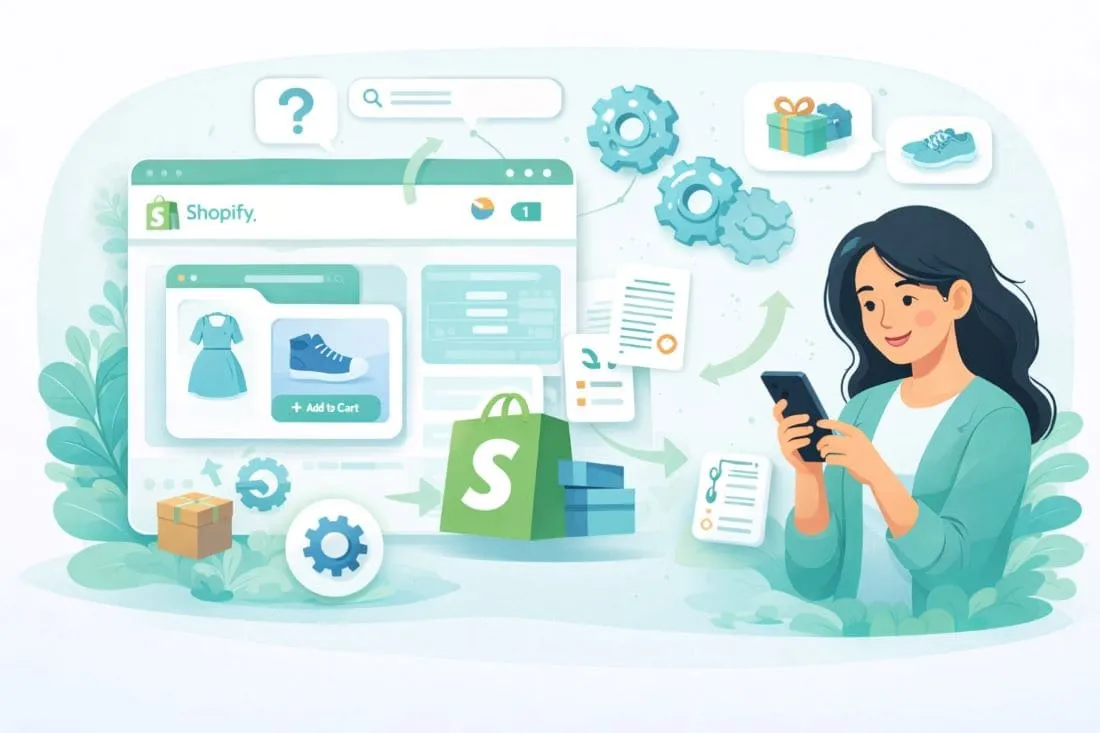
A Shopify AI chatbot is a conversational assistant built for a Shopify store. It helps shoppers by answering questions, finding products, explaining policies, assisting with order related requests, and guiding people toward purchase. Unlike a basic chat widget that follows fixed scripts, an AI chatbot can understand natural language, follow context, ask follow up questions, and generate replies based on the store’s actual data.
In simple terms, a Shopify AI chatbot sits between the shopper and the store’s information. The shopper asks a question such as “Which moisturizer is best for dry skin?” or “Where is my order?” The Shopify chatbot interprets the request, looks at the right data source, and responds in plain language. If it is connected well, it can use product information, store policies, cart details, customer account data, and business rules to give a useful answer. That is what makes it valuable. It reduces friction for shoppers and reduces repetitive work for the support team.
Why Shopify stores are using AI chatbots
Most e-commerce stores face the same problem. Shoppers want answers before they buy, and support teams spend too much time replying to the same questions. People ask about shipping, returns, sizing, compatibility, ingredients, stock, discounts, delivery times, and order status. The best AI chatbot helps in two major ways. First, it improves the customer experience by answering faster and guiding shoppers toward the right product. Second, it reduces manual effort by taking care of repetitive questions that do not always need a human agent.
This matters because product discovery is rarely perfect. Many shoppers do not know the exact search terms they should use. They think in goals, use cases, budgets, and preferences. A conversational interface helps bridge that gap. It turns a static catalog into an interactive assistant.
What makes an AI chatbot different from a basic chatbot
Older chatbots are usually rule-based. They depend on keyword matching and prewritten flows. If a customer says exactly what the bot expects, it works. If the customer asks in a different way, combines multiple questions, or asks for advice, the bot often fails.
A Shopify AI chatbot works differently. It uses natural language understanding and large language models to understand meaning, not just keywords. It can handle questions like “I need a gift under $100 for someone who loves clean skin care” or “Show me the same product in a waterproof version.” That makes it much more useful for real shopping conversations.
That does not mean every AI answer is correct. Accuracy depends on how the system is connected, what data it can access, how well the store content is structured, and what safeguards are in place. A weak setup still produces weak answers. A strong setup with good data and clear boundaries performs much better.
GoodChatbot by Automatikly is a useful reference point here. It is what a strong setup looks like in practice: purpose-built for Shopify, trained on real store data, and designed to act on behalf of the shopper, not just respond to them. See how it delivers on this in the benefits section below.
How a Shopify AI chatbot works
At a high level, an AI chatbot for Shopify usually has six parts.
1. The chat interface
This is the part the shopper sees on the website. It may appear as a chat bubble, a side panel, or a full screen assistant. The customer types a question, and the interface sends that message to the backend system.
2. The language model
The backend sends the customer’s message to an AI model. The model tries to understand intent. Is the shopper asking for a product suggestion, a shipping answer, a return request, or help with an order? This is where the system decides what kind of answer is needed.
3. The store context layer
This is the part many people miss. The AI model on its own does not know the merchant’s store. It needs context. That context may include product catalog data, collections, policies, FAQ content, reviews, blog content, stock signals, cart contents, and sometimes customer account details.
4. Retrieval from store content
For policy and support questions, the chatbot often retrieves the right content from a knowledge source before generating a reply. This matters because it grounds the answer in the store’s real information instead of asking the AI to guess. The cleaner the source content, the better the answers tend to be.
5. Actions and tools
Some chatbots do more than talk. They can take actions. For example, they may search the catalog, show matching products, create or update a cart, surface checkout links, or fetch order information for a logged in customer. This is where a true store assistant becomes more powerful than a simple help bot.
6. Guardrails and human review
A production chatbot needs limits. It should know what it can answer, what data it can access, and when it should hand the conversation to a human. This is especially important for policy claims, order issues, refunds, and product advice that could affect trust. Good systems also log chats, track failure cases, and improve over time using real customer conversations.
What kinds of questions can it answer
A Shopify AI chatbot can usually support three broad categories of questions.
Product discovery questions such as “Which size should I buy?” “What is the difference between these two products?” or “Show me something similar under this price.”
Store policy and support questions such as shipping rules, return windows, exchange conditions, warranty details, ingredients, care instructions, and FAQ style content.
Post purchase help questions such as order status, delivery updates, returns, and account related requests.
What data does the chatbot need
A Shopify AI chatbot is only as good as the information it receives. At minimum, it should have access to product titles, product descriptions, variants, pricing, availability, collections, shipping and return policies, FAQ content, cart contents, and customer account data where permitted.
Many stores also improve results by adding reviews, compatibility details, structured product attributes, and internal business rules. This is why plug and play setups often disappoint merchants. If the store data is weak, outdated, inconsistent, or incomplete, the chatbot will struggle. AI does not magically fix poor source content. It amplifies whatever structure and clarity already exist in the store.
What are the biggest benefits
The biggest benefit is faster customer help. A shopper can ask a question in plain language and get an instant answer instead of browsing multiple pages or waiting for support.
The second benefit is better product discovery. A shopper often does not know the exact keyword to search. Conversational AI can help narrow choices based on goals, use case, budget, skin type, room size, gift intent, or other human inputs.
The third benefit is operational efficiency. A good chatbot can handle a large share of repetitive queries, freeing the support team to focus on difficult cases.
GoodChatbot by Automatikly
All three of those benefits depend on the same thing: a chatbot that is trained on your store, connected to your live data, and built to act, not just answer.
GoodChatbot is a Shopify AI based chatbot developed by Automatikly that is handcrafted around each store’s product, customers, and historical interactions rather than deployed off the shelf.
What it does: Answer product questions and compare items based on shoppers' requirements. Handle order status and return requests inside the chat window. Adds to cart and initiates checkout without shoppers leaving the conversation. Switches the language automatically based on how the customer writes. Connects to Shopify apps, CRM, and third-party tools so store data stays unified.
Built after working with 1000 stores. 86% improvement in conversion. Rated 5/5 by merchants.
What are the limitations
A Shopify AI chatbot is not magic. It can still make mistakes. It may misunderstand unclear questions, answer too confidently when it should ask for clarification, or give incomplete responses if the store content is missing details.
There is also a difference between answering and acting. Answering a question is easier. Taking a real action such as checking an authenticated order, processing a return request, or moving a cart toward checkout requires proper integrations, permissions, and business logic.
Where this is going next
The role of the Shopify chatbot is expanding. It is no longer just a support box in the corner of the screen. It is becoming part of product discovery, decision support, and in some cases the path to purchase itself. Merchants also need to think about AI discovery outside their own site, because AI search tools are increasingly shaping how shoppers find answers and brands.
Final thoughts
A Shopify AI chatbot is best understood as a store assistant, not just a chat feature. It works by combining a language model with live store context, structured source content, and action tools. When implemented well, it can answer support questions, guide product discovery, improve response speed, and reduce manual effort. When implemented badly, it becomes just another bot that frustrates customers.
So the real question is not whether a Shopify AI chatbot can work. It can. The real question is whether it has access to the right data, the right rules, and the right boundaries to serve customers well. That is what separates a useful assistant from a generic chatbot.
Frequently asked questions
What is a Shopify AI chatbot?
A Shopify AI chatbot is a conversational assistant built for a Shopify store. It can answer product, policy, cart, and order related questions using the store’s actual data and connected systems.
How does a Shopify AI chatbot work?
It combines a chat interface, an AI model, store data, a knowledge source, and action tools. When a shopper asks a question, the system identifies intent, pulls the right context, and generates a response or completes an allowed action.
Can a Shopify AI chatbot help with sales as well as support?
Yes. A well connected chatbot can guide product discovery, compare products, answer pre purchase questions, suggest related items, and also reduce support load by handling repetitive service requests.
Why do many Shopify AI chatbot projects fail?
Most failures come from weak store data, incomplete knowledge content, poor integration, no clear handoff rules, and no process for monitoring and improving answers after launch.
References
-
Shopify. AI Personal Shopper: How AI Agents Can Help Customers Shop. March 17, 2026.
-
Shopify. AI in Ecommerce: 7 Ways to Get Started in 2026. Updated March 26, 2026.
-
Shopify. AI Knowledge Base: Complete Guide for Ecommerce. December 10, 2024.
-
Shopify. GEO for Ecommerce: How To Drive Traffic To Your Store From AI. February 13, 2026.
-
Shopify. Agentic Commerce: Benefits and How To Get Started. April 2, 2026.