Why Generic Plug-and-Play Chatbots Fail for Shopify Stores
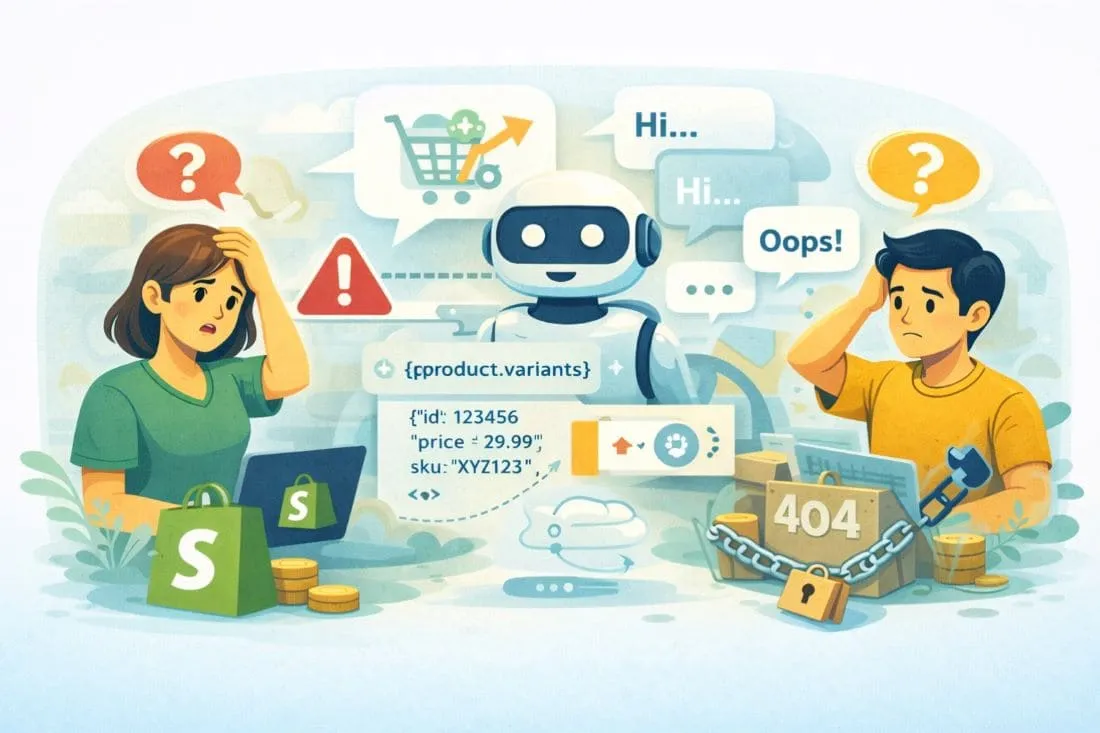
Every week, thousands of Shopify merchants install a Shopify chatbot app, spend an afternoon configuring it, watch it go live, and then quietly turn it off two months later. The app store reviews tell the story clearly: "Looked great in the demo but customers hate it." "Keeps giving wrong answers about our products." "More trouble than it is worth." "Switched back to email."
This is not a coincidence and it is not bad luck. It is a structural problem with how generic plug-and-play chatbots are built and what they are actually capable of delivering for a real chatbot for a Shopify store.
The global chatbot market was valued at $5.1 billion in 2024 and is projected to exceed $27 billion by 2030, according to Grand View Research. Adoption is surging. But adoption rates and success rates are two very different things. Gartner research consistently shows that chatbot satisfaction scores in e-commerce remain among the lowest of any digital customer service channel. The technology is everywhere. The results are often disappointing.
This article explains why. Not in vague terms, but specifically: what generic chatbots cannot do, where they fail in the Shopify context, what the research shows about the commercial consequences, and what merchants who want a chatbot that actually works need to do differently.
If you are thinking about installing a chatbot on your Shopify store, read this first. If you already have one that is underperforming, this article will tell you exactly why.
What "Generic Plug-and-Play" Actually Means
The Promise vs. The Reality
Generic plug-and-play chatbots are products built to be installed by anyone, on any kind of website, with minimal setup. They are designed for breadth, not depth. The value proposition is speed: you can have a chatbot live in under an hour without writing a single line of code.
This is genuinely useful for certain use cases. A law firm that wants a chatbot to collect contact details from website visitors. A restaurant that needs to answer questions about its hours and location. A SaaS company that wants to surface help documentation. For these use cases, a generic chatbot can work reasonably well because the scope is narrow, the data is simple, and the customer expectations are low.
An e-commerce store on Shopify is a fundamentally different environment. Customers come to a Shopify store with specific, dynamic, data-dependent questions. They want to know the status of a specific order placed three days ago. They want to know whether a specific product in a specific color is currently in stock. They want to know whether their specific address falls within your free shipping zone. They want to understand what will happen if they return a product they bought during a sale.
None of these questions can be answered by a chatbot that is not connected to your live Shopify data. And most generic plug-and-play chatbots are not.
The Disconnect Between Demo and Deployment
The demo environment for most chatbot products is carefully controlled. Vendors show you a chatbot answering questions smoothly, routing conversations correctly, and handing off to human agents gracefully. What they do not show you is what happens when a real customer asks a question that does not match any of the pre-configured flows, or when a customer asks about an order that was placed last Tuesday and the chatbot has no access to order data.
This gap between demo and deployment is the single most common source of merchant disappointment with chatbot products. The demo works because it was designed to work. Deployment fails because the real world is messier than the demo.
Research from Forrester on enterprise chatbot deployments found that 54% of customers who had a negative chatbot experience said the bot "could not understand what I was asking," and 42% said it "gave me information that was wrong or unhelpful." These numbers come from real deployments, not demos.
Who Builds These Products and Why
Understanding why generic chatbots are built the way they are helps explain their limitations.
Generic chatbot companies are building for the broadest possible market. They need a product that can be installed on a hardware store's website, a fitness studio's website, a law firm's website, and a Shopify fashion store's website, with roughly the same setup process. This forces them toward the lowest common denominator: a product that asks customers to choose from a menu of options, routes them to pre-written answers, and escalates to a human when anything unexpected happens.
The economics of their business model also matter. They charge small monthly fees and need to serve large volumes of customers. Investing heavily in deep integrations with specific platforms like Shopify is a longer development cycle and higher maintenance burden than building a generic product. So most of them offer Shopify integrations that are shallow: they can display your store name in the chat window, and maybe pull in a few product names, but they cannot query live order status, check real-time inventory, calculate shipping for a specific address, or access a customer's purchase history.
This is not malice. It is the predictable result of a product strategy optimized for broad distribution rather than deep utility.
The Specific Ways Generic Chatbots Fail Shopify Stores
Failure 1: They Cannot Answer the Most Common Customer Support Questions
Ask any Shopify merchant what their top three most common customer service questions are. Across virtually every product category, the answers are remarkably consistent: where is my order, can I return or exchange this, and do you ship to my location or how long will delivery take?
These three question types account for the majority of customer service volume for most Shopify stores. According to data published by Gorgias, a chatbot for a customer service platform that works specifically with e-commerce stores, order status questions alone account for between 30% and 40% of all inbound customer service contacts for the average Shopify store.
A generic chatbot cannot answer any of these questions accurately without live Shopify data integration. It does not know what orders exist. It does not know what shipping zones you have configured. It does not know your current return policy unless you have manually typed it out in the chatbot's configuration. And even then, it can only give a static answer, not one that accounts for the specific circumstances of the customer's situation.
The practical result: a customer asks about order tracking in Shopify and the chatbot responds with something like "Please enter your order number and we will look into that for you" and then does nothing useful with the response because it has no system to look into. The customer gives up and sends an email. You have now spent money on a chatbot that redirected customers to the channel you were trying to reduce load on.
Failure 2: They Hallucinate or Confabulate Product Details
Many modern generic chatbots use large language models under the hood. This gives them fluency and the ability to handle a wider range of inputs than older rule-based systems. But it also introduces a serious problem for e-commerce: these models can generate confident, detailed, completely wrong answers about your products.
If a customer asks whether your skincare serum is safe for sensitive skin and your chatbot is powered by a general-purpose language model that is not grounded in your actual product data, the bot might generate an answer that sounds plausible but is based on general knowledge about skincare serums rather than the specific formulation of your product. If that answer is wrong and a customer has a reaction, you have a customer service disaster that originated with your chatbot.
If a customer asks about the weight capacity of a piece of furniture you sell and the chatbot invents a number based on similar products it was trained on, you have a safety issue and a liability risk.
This is not a hypothetical problem. It is happening at scale across e-commerce stores using generic AI chatbots without proper grounding in verified product data. The MIT Technology Review has reported extensively on the phenomenon of AI confabulation in customer-facing applications, noting that the combination of confident tone and incorrect information is particularly damaging in commercial contexts because customers have no way to know the answer is wrong.
Failure 3: They Destroy Brand Voice
Your brand is not generic. You have built a specific personality, a tone, a way of communicating with customers that reflects who you are and who your customers are. A sustainable outdoor gear brand sounds different from a luxury jewelry brand. A playful children's toy company communicates differently from a professional photography equipment supplier.
Generic chatbots have a generic voice. It is usually something between overly cheerful customer service representative and robotic FAQ delivery system. It uses phrases like "Great question!" and "I'd be happy to help with that!" and "I'm sorry to hear you're having trouble!" regardless of whether those phrases fit your brand at all.
This matters more than most merchants expect it to. Research from Salesforce's State of the Connected Customer report found that 88% of customers say the experience a company provides is as important as its products or services. Brand voice is a core part of that experience. A chatbot that sounds nothing like your brand is an active negative, not a neutral. It signals to customers that the automated part of your business has a completely different personality from the rest of it, which erodes the coherence of the brand experience.
For premium or luxury brands, this effect is particularly pronounced. A chatbot responding to a customer who just purchased a $400 handbag with "Hey there! How can I help you today?" is not just tonally wrong. It undermines the entire premium positioning of the product.
Failure 4: They Create Decision Tree Dead Ends
Most generic chatbots are fundamentally decision tree systems with a conversational veneer. They present customers with a menu of options, each of which leads to another set of options or a pre-written response. When a customer's question does not fit any of the configured branches of the decision tree, the bot hits a wall.
The wall typically looks like one of three things: the bot loops back to the main menu, the bot says it cannot help and offers to connect the customer with a human agent, or the bot gives a vague, generic response that does not actually answer the question.
Each of these outcomes is a failed interaction. And in e-commerce, failed interactions have direct commercial consequences. Baymard Institute research on checkout abandonment found that customers who encountered problems during the support phase of their purchase journey were 2.4 times more likely to abandon their cart than those who got their questions answered successfully.
The decision tree architecture also creates a frustrating experience for customers who know exactly what they want but are forced to navigate a series of menus to get to it. A customer who wants to know whether a specific item can be gift wrapped does not want to choose between "Order Questions," "Product Questions," "Returns," and "Other." They want to type their question and get an answer. Forcing them through a menu structure designed around your chatbot's limitations rather than their actual needs signals that the tool was built for the company's convenience, not the customer's.
Failure 5: They Have No Memory Within or Across Sessions
Generic chatbots typically treat every conversation as if it is the first time they have ever talked to a customer. Within a single session, many cannot maintain context from one message to the next. A customer who explains their situation in the first message may find they need to explain it again two messages later because the bot has already lost track of the context.
Across sessions, the amnesia is almost universal. A customer who contacted your chatbot yesterday about a delivery issue and is back today to follow up starts from scratch. There is no record of what was discussed. There is no acknowledgment that this customer has been waiting for a resolution. There is no continuity of service.
This is not just frustrating. It is actively damaging to customer relationships. Research from Zendesk found that 72% of customers expect support agents to know who they are, what they have purchased, and what interactions they have had with the company previously. When a chatbot fails to meet this expectation, customers do not blame the chatbot. They blame the brand.
The Shopify environment makes this particularly consequential. Shopify stores have access to rich customer data: order history, purchase frequency, lifetime value, previous support interactions. A chatbot that is not integrated with this data is ignoring the single most valuable resource available for personalizing the customer service experience.
Failure 6: They Handle Escalation Badly
When a generic chatbot cannot resolve a customer's issue, which happens frequently, the escalation to a human agent is often poorly handled.
The problems are multiple. The handoff usually happens without context: the human agent receives a message from the customer but has no record of what the chatbot conversation contained, forcing the customer to explain their issue all over again from the beginning. Salesforce's research on customer expectations found that having to repeat yourself to multiple agents or systems is the single most frustrating aspect of the customer service experience, cited by 68% of customers.
Generic chatbots also typically have blunt escalation triggers. They might escalate after three consecutive failed responses, or when a customer uses specific keywords like "speak to a human" or "representative." But they do not escalate intelligently based on the nature of the issue, the customer's emotional state, the commercial value of the customer, or the complexity of what is being asked.
Research from Bain and Company on customer loyalty found that customers who had a service issue resolved in their first contact were more likely to repurchase than customers who never had an issue at all. The first contact resolution rate, when measured for generic chatbots in e-commerce contexts, is substantially lower than for purpose-built solutions.
Failure 7: They Perform Badly on Mobile
More than 70% of Shopify store traffic comes from mobile devices. Generic chatbots were typically designed for desktop environments and adapted for mobile as an afterthought. The results are often poor.
Common mobile chatbot failure points include chat windows that obscure the product or checkout content behind them, input fields that behave erratically when the phone's keyboard appears, slow load times that make the chatbot appear unresponsive on slower mobile connections, text that is too small to read comfortably on a phone screen, and tap targets that are too small for reliable use with a finger rather than a mouse cursor.
Research from the Baymard Institute on mobile e-commerce usability consistently identifies support and chat functionality as among the most poorly implemented mobile UX elements across e-commerce sites. When a chatbot degrades the mobile experience rather than enhancing it, it is making a negative contribution to conversion for the majority of your traffic.
Failure 8: They Cannot Handle Shopify-Specific Workflows or Chatbot Integration
Shopify has its own operational logic. Without proper Shopify chatbot integration, refund workflows, exchange processes, discount code applications, variant-level inventory, subscription orders, B2B pricing tiers, draft orders, and multi-location fulfillment all have their own structure within Shopify that a generic chatbot has no awareness of.
When a customer wants to exchange a product rather than return it, a generic chatbot can tell them "we accept exchanges within 30 days," but cannot actually initiate, track, or facilitate the exchange workflow within Shopify. When a customer wants to apply a discount code they received by email, but cannot figure out where to enter it, a generic chatbot can describe the checkout process in general terms, but cannot navigate the customer through the specific Shopify checkout flow.
When a customer has a subscription order through a Shopify subscription app and wants to skip a delivery or change their next order date, a generic chatbot has no access to that subscription data and cannot help. The customer is left on their own, which typically means either a support ticket or a cancellation.
These gaps between what customers need and what generic chatbots can deliver are not edge cases. They are the routine interactions that define the customer service experience for most Shopify stores.
What the Research Says About the Commercial Consequences
The Direct Revenue Impact
The commercial consequences of generic chatbot failure are not abstract. They show up in conversion rates, return customer rates, and average order values.
Research published by Juniper Networks estimated that poorly performing chatbots cost e-commerce businesses $75 billion per year in lost sales due to customer frustration and abandonment. While large-scale aggregate estimates like this always come with uncertainty, the directional finding is consistent with other research: chatbots that do not work well actively cost money rather than saving it.
Invesp's research on e-commerce conversion found that a negative chatbot interaction reduced the probability of purchase completion by 28% compared to customers who had no chatbot interaction at all. This finding is particularly damaging because it means a badly configured generic chatbot is not just failing to help, it is actively worse than doing nothing.
The effect compounds over time. A customer who has a bad chatbot experience does not just fail to complete that purchase. They are less likely to return to the store. Research from PwC found that 59% of consumers will walk away from a brand after multiple bad experiences, and 17% will walk away after just one bad experience. A chatbot that consistently fails is a consistent source of bad experiences at scale.
The Customer Lifetime Value Calculation
The standard way that chatbot vendors frame the ROI of their product is in terms of cost savings: you pay for the chatbot and save on human agent costs. This framing misses the more important calculation, which is the impact on customer lifetime value.
A Shopify store's long-term profitability depends heavily on repeat customers. Research from Shopify's own commerce reports consistently shows that repeat customers spend more per order, have lower acquisition costs, and are more likely to refer new customers than first-time buyers. Anything that damages the repeat purchase rate damages the long-term economics of the business far more significantly than the monthly cost of a chatbot subscription.
If a generic chatbot reduces the repeat purchase rate from international customers by 10% because of language and cultural mismatches, or reduces it from first-time customers by 15% because of failed support interactions, the actual cost to the business in lifetime value terms could be ten to twenty times the monthly cost of the chatbot platform. This is the calculation that most merchants never run, because the damage is diffuse and attributed to other causes rather than directly to the chatbot.
The Support Ticket Paradox
One of the most consistent findings from merchants who deploy generic chatbots and then review their support metrics is what you might call the support ticket paradox: after installing the chatbot, their human support ticket volume goes up rather than down.
This happens for a predictable reason. The chatbot fails to resolve customer questions. Customers try the chatbot, get no useful answer, and then contact support via email or phone. They are now more frustrated than they would have been if they had just gone straight to email, because they have already spent time failing to get help from the chatbot. The support ticket they send is more urgent in tone, sometimes includes a complaint about the chatbot itself, and requires more agent time to resolve because the customer is already agitated.
Research from Gorgias on e-commerce support metrics found that stores with poorly configured chatbots saw an average 23% increase in support ticket volume in the first three months after chatbot deployment, compared to a 35% reduction in ticket volume for stores with well-configured, properly integrated chatbots. The difference between these two outcomes is not the technology itself. It is the depth of integration and the quality of configuration.
Trust Erosion and Brand Damage
Beyond the measurable metrics, there is a subtler consequence of generic chatbot failure that is harder to quantify but equally important: brand trust erosion.
When a customer interacts with a chatbot that cannot answer their questions, gives them wrong information, sounds nothing like the brand they chose to shop with, and forces them to repeat themselves multiple times, they form a specific opinion about the brand: that it does not value their time or experience enough to invest in actually helping them.
This opinion does not stay private. Research from BrightLocal on consumer reviews found that customers are three times more likely to leave a review after a negative experience than after a positive one. In the social media era, a customer who had a frustrating chatbot experience is a potential source of public negative feedback that reaches far beyond their own future purchasing behavior.
Nielsen's research on consumer trust found that 84% of people trust recommendations from friends and family more than any other form of advertising. A customer who tells a friend "I tried to get help from their chatbot and it was completely useless" is doing more damage to your customer acquisition than almost any other single outcome.
Why Merchants Keep Installing Generic Chatbots Anyway
The Ease Trap
The fundamental appeal of generic plug-and-play chatbots is that they are easy. Installing a Shopify app takes minutes. The setup wizard guides you through a few configuration steps. The chatbot is live before lunch. This ease is genuinely attractive for time-pressed merchants who are managing marketing, operations, inventory, and customer service simultaneously.
The problem is that ease of installation does not correlate with effectiveness. It correlates with ease of installation. A chatbot that takes three minutes to install and delivers poor results is not a better investment than a chatbot that takes three weeks to configure and delivers strong results. But the cognitive bias toward immediate action over future effectiveness is powerful, and chatbot vendors exploit it deliberately with marketing language focused on speed and simplicity.
The Demo Effect
As mentioned earlier, chatbot demos are optimized for success. Vendors show their products under ideal conditions, answering questions they have specifically prepared for, in a controlled environment that does not reflect the messiness of real customer interactions.
The demo effect is amplified by the fact that most merchants evaluate chatbots by interacting with the demo themselves, as a customer who knows what the product is supposed to do. Real customers do not come to your chatbot with that knowledge. They come with their own specific, unpredictable questions, their own communication styles, their own emotional states, and their own levels of patience.
The Sunk Cost Problem
Once a chatbot is installed and live, removing it creates friction. The merchant has spent time configuring it, their team has adapted to it, and removing it feels like admitting a mistake. Many merchants keep underperforming chatbots running far longer than they should because the psychological cost of admitting failure and starting over feels higher than the ongoing cost of a chatbot that is not working.
This is a well-documented cognitive bias, the sunk cost fallacy, and it keeps bad chatbots running on Shopify stores long after the evidence is clear that they are not helping and may be hurting.
The Price Signal Problem
Generic chatbots are cheap. Many offer free tiers or prices under $50 per month. This price point makes them easy to justify without rigorous ROI analysis. If the chatbot costs $30 per month and seems to be handling some conversations, the merchant does not need to do a detailed analysis to feel that they are getting value.
The problem is that $30 per month is also cheap enough that merchants do not feel compelled to invest the time in proper configuration, testing, and ongoing optimization. If you are paying $500 per month for a chatbot, you are going to take its performance seriously. If you are paying $30, the tendency is to install it, do a surface-level setup, and leave it running without close monitoring.
The combination of low price and low effort creates predictably low results. And because the stakes feel low, the learning from failure is limited.
What a Shopify Chatbot Actually Needs to Do Well
Deep Shopify Chatbot Integration and Data Access
The foundation of a useful AI chatbot for Shopify is real-time access to the data that customers are actually asking about. At minimum, this means live integration with order data (status, tracking, fulfillment), product data (availability, variants, descriptions, images), customer data (purchase history, account details, previous interactions), and policy information (returns, shipping, warranties).
Without this integration, a chatbot answers questions about your store with general knowledge, not actual knowledge. The integration needs to be live, not cached. An order status that was accurate four hours ago may not be accurate now if the fulfillment happened this afternoon. Inventory that showed in stock this morning may be sold out by the time a customer asks about it this evening.
This level of integration requires either a chatbot platform built specifically for e-commerce with native Shopify API connectivity or a custom integration built on top of a general AI platform. It cannot be achieved by a generic chatbot relying on a shallow Shopify app connection.
Genuine Conversational AI, Not Decision Trees
A chatbot that routes customers through menus is not solving the fundamental problem of customer service: people ask unexpected questions in unexpected ways. The solution to this is genuine natural language understanding, combined with a robust knowledge base that is deep enough to handle the range of questions your specific customers ask.
This does not mean the most sophisticated AI model available. It means a model that is properly configured, grounded in your actual store data, and tested against the real questions your customers ask. A well-configured chatbot with strong grounding will outperform a sophisticated model with poor grounding every time.
Brand Voice Configuration
A chatbot that sounds like your brand requires deliberate, detailed configuration. This starts with a thorough system prompt that defines your brand's voice: its level of formality, its personality traits, the phrases it uses and avoids, the way it handles complaints, the way it acknowledges customer feelings.
It extends to testing: reviewing chatbot responses against real customer messages and asking whether the response sounds like something your brand would actually say. It includes iteration: updating the configuration based on feedback and performance data until the chatbot sounds genuinely native to your brand rather than like a generic customer service bot.
This configuration work takes time. But the result is a chatbot that reinforces your brand rather than undermining it.
Intelligent Escalation
A well-designed chatbot needs to know not just when it cannot answer a question, but when escalation serves the customer better even if the bot could technically provide an answer. A high-value customer who is clearly frustrated deserves human attention regardless of whether the bot has a response prepared. A complaint about a product defect probably should not be handled by an AI, even if the bot is capable of processing return requests.
Intelligent escalation means configuring the chatbot with specific rules about when to escalate, what information to pass to the human agent at the point of handoff, and how to communicate the escalation to the customer in a way that feels like a warm transfer rather than an abandonment.
Mobile-First Design
Given that the majority of Shopify traffic is on mobile, a chatbot that works excellently on mobile is not optional. This means a chat interface that does not obstruct content, responds quickly on mobile connections, handles the keyboard pop-up gracefully, uses text sizes and tap targets appropriate for mobile screens, and maintains session state reliably across the interruptions that characterize mobile browsing.
The standard for mobile chatbot UX should be the same as the standard for the rest of your Shopify store's mobile experience: smooth, fast, and frustration-free.
Continuous Learning and Maintenance
A Shopify store is not static. Products change, policies change, pricing changes, seasonal promotions change, and inventory levels change constantly. A chatbot's knowledge needs to reflect these changes in real time or near real time, or it will give outdated answers that erode customer trust.
This requires an ongoing maintenance process: someone responsible for updating the chatbot's knowledge base when policies change, monitoring performance metrics to catch degradation early, reviewing flagged conversations where the bot failed or gave a wrong answer, and updating the system prompt and knowledge base based on new patterns in customer questions.
Without this ongoing maintenance, even a well-configured chatbot degrades over time. The question merchants need to ask before deploying any chatbot is not just "what does it cost to set up" but "what does it cost to maintain properly, and do we have the capacity to do that?"
The Path from Generic to Purpose-Built
Assessing What You Actually Need
Before choosing any chatbot solution, spend time characterizing your actual support landscape. Pull three months of support ticket data and categorize every ticket. What percentage is about the order status? Returns and exchanges? Product questions? Shipping? Account issues? Something else?
This analysis will tell you two things first: where your chatbot needs to be strongest, which should drive your integration requirements. Second, how complex your customer questions actually are, which should drive your choice of AI sophistication.
A store whose support tickets are 60% order status questions and 20% return policy questions has a very different chatbot requirement from one whose tickets are 40% detailed product compatibility questions and 30% complaints requiring empathy and resolution authority.
Choosing Between Platform and Custom Build
For most Shopify merchants, the choice is between a purpose-built e-commerce chatbot platform, one designed specifically for e-commerce rather than for all industries, and a custom implementation built on top of a foundation model.
Purpose-built chatbot for e-commerce platforms like Gorgias, Tidio's e-commerce -specific tier, and emerging players focused on AI chatbots for Shopify have deeper out-of-the-box integrations with Shopify data and pre-configured responses for common e-commerce question types. They require less custom configuration and are typically faster to deploy effectively.
Custom implementations built on foundation model APIs give you more control over the chatbot's behavior, knowledge, and brand voice, but require more technical investment and ongoing maintenance capacity.
The right choice depends on your technical resources, your budget, and how differentiated your customer service needs are. A store with straightforward, high-volume tier-1 queries may be well-served by a purpose-built platform. A store with complex, specialized product questions, a distinctive brand voice, and high value transactions may need a custom implementation to achieve the quality it requires.
The Configuration Investment
Regardless of which path you choose, expect to invest real time in configuration before launch. Key areas include:
-
Writing detailed policy documentation that the chatbot can reference, covering edge cases, exceptions, and the what-if scenarios that customers actually encounter.
-
Creating a comprehensive product knowledge base for your most-asked-about items, including not just specifications but the questions customers actually ask.
-
Testing the chatbot with real customer questions from your support history, not idealized questions. The gaps this reveals are the gaps that will frustrate real customers.
-
Defining escalation rules clearly, based on question type, customer value, emotional signals in the conversation, and time of day relative to your support team's availability.
Measuring the Right Things After Launch
Once your chatbot is live, the metrics that matter are outcome metrics: containment rate (the percentage of conversations resolved without human escalation), customer satisfaction scores from post-conversation ratings, the impact on your support ticket volume, and conversion rate from customers who interacted with the chatbot versus those who did not.
Segment these metrics by question type and by customer segment. A chatbot that performs well for order status questions but poorly for product questions has a specific gap to fix. Aggregate metrics hide these patterns.
Review the metrics weekly in the first month and establish a monthly review cadence after that. A chatbot without an active owner and regular review will drift toward underperformance over time as your store changes and the chatbot's knowledge becomes stale.
Why goodChatBot Does Not Have the Same Problems as Generic Shopify Chatbots
Most generic chatbots give the same shallow answers regardless of the store they are in. GoodChatbot by Automatikly works differently. As a purpose-built Shopify AI chatbot, it is trained on your actual product catalog, store policies, FAQs, and support workflows before it goes live. That means when a customer asks about order tracking in Shopify, a return, or a product-specific question, it gives a real answer grounded in your store data, not a guess.
Unlike plug-and-play tools, we do not just hand you a generic setup. We customize the AI chatbot for Shopify around your specific store, using app data, external sources, and internal systems to train it properly. That is what makes the difference between a customer support chatbot that frustrates shoppers and one that actually moves them toward a purchase.
The benefits of an AI chatbot for Shopify are only real when the chatbot is built for e-commerce, not retrofitted from a generic website tool. goodChatBot supports the full customer journey, from product discovery and pre-purchase questions to post-purchase support and smooth handoff to your team when needed. And because your store changes over time, we continuously monitor, refine, and improve it so it stays accurate and useful long after launch. Book a free demo and see how it works on your store.
The Problem Was Never Chatbots. It Was the Wrong Chatbot for Shopify
Generic plug-and-play chatbots fail for Shopify stores because they were never designed for what Shopify stores actually need. They were designed to be easy to install on any website. Shopify stores are not generic websites. They are complex e-commerce environments with live inventory, dynamic order data, specific operational workflows, and customers who come with specific, data-dependent questions that require real integration to answer accurately.
The research is detailed and consistent: poorly configured chatbots in e-commerce actively damage conversion rates, customer retention, and brand trust. The easy-to-install chatbot for Shopify that takes an afternoon to set up and then runs quietly in the background is not neutral. It is costing you customers and revenue in ways that are real but diffuse enough to be attributed to other causes.
The solution is not to avoid AI chatbots for Shopify. Properly built and configured, chatbots deliver genuine commercial value for Shopify stores: lower support costs, faster resolution times, higher customer satisfaction, and improved conversion rates. The research on well-implemented chatbots is just as detailed as the research on poorly implemented ones, and it points in the opposite direction.
The solution is to take the configuration work seriously, choose a platform or approach that is built for e-commerce rather than for everything, invest in deep Shopify data integration, test with real customer questions before launch, and maintain the system actively after launch.
The difference between a chatbot that works and one that doesn't is the technology. It is the quality of the implementation. That quality takes time and effort to achieve. But compared to the cost of running a chatbot that is actively hurting your business, the investment is straightforward to justify.
Frequently Asked Questions
Are all plug-and-play Shopify chatbots bad?
Not categorically. Some purpose-built e-commerce chatbot platforms have developed Shopify-specific integrations that are deep enough to handle common use cases well. The problem is specifically with generic chatbots designed for all industries that happen to offer a Shopify app. If a chatbot platform was built with e-commerce as its primary use case, has native Shopify API integration, and allows deep configuration of brand voice and knowledge, it may work well even if the installation process is straightforward.
How do I know if my current chatbot is hurting my store?
Check your support ticket volume before and after chatbot installation. If tickets increased, that is a strong signal. Check your chatbot's containment rate: what percentage of conversations does it resolve without human escalation? Below 30% in the first 90 days suggests serious configuration problems. Review a sample of actual chatbot conversations from the last 30 days and count how many gave accurate, helpful answers versus vague, wrong, or unhelpful ones.
How much does a properly configured Shopify chatbot cost compared to a generic one?
Generic plug-and-play chatbots typically cost between $0 and $100 per month. Purpose-built e-commerce chatbot platforms with Shopify integration typically cost between $100 and $600 per month. The meaningful comparison is not monthly platform cost but ROI: a $30 per month chatbot that reduces your conversion rate by 5% is far more expensive than a $400 per month chatbot that increases it by 15%.
What should a good AI chatbot for order tracking in Shopify be able to do?
A good AI chatbot for order tracking in Shopify should connect directly to your live Shopify order data so it can give customers a real-time status update without involving your support team. It should be able to pull carrier-level tracking information, confirm delivery estimates, and handle follow-up questions about delays or missing orders, all within the same conversation.
Can a chatbot ever fully replace human customer service agents for a Shopify store?
No, and attempting to do so is a mistake. The right model is a chatbot that handles the high volume, low complexity tier-1 queries autonomously while routing complex, emotional, or high-value interactions to human agents who can apply judgment, empathy, and authority that AI cannot replicate. Stores that use chatbots to replace human agents entirely see significant declines in customer satisfaction and retention for the query types that require human handling.
How long does it take to properly configure a Shopify chatbot?
For a purpose-built e-commerce platform with good documentation and support, expect 2 to 4 weeks of real configuration work before launch. For a custom implementation, 6 to 12 weeks is more realistic. The tendency to rush this timeline is the single most reliable predictor of disappointing results.
What is the first thing I should fix if my current chatbot is underperforming?
Connect it to live Shopify order data. If your chatbot cannot answer "where is my order" accurately, it is failing on your highest-volume question type. This single integration improvement will have the largest impact on containment rate and customer satisfaction of any single change you can make. If your chatbot platform does not support this integration, that is your signal to consider switching platforms.
References
-
Grand View Research — Chatbot Market Size, Share and Trends Analysis Report 2024 to 2030
-
Gartner — Gartner Predicts Chatbot Platforms Will Handle 70% of Customer Conversations by 2025
-
Forrester Research — The State of AI in Customer Service 2024
-
Gorgias — The State of Ecommerce Customer Support 2024
-
MIT Technology Review — When AI Gets It Wrong: The Growing Problem of AI Confabulation
-
Salesforce — State of the Connected Customer, 6th Edition
-
Baymard Institute — Mobile Ecommerce UX Research: Checkout Abandonment Study
-
Zendesk — CX Trends 2024: The Future of Customer Experience
-
Bain and Company — Closing the Delivery Gap: How to Achieve True Customer-Led Growth
-
PwC — Experience Is Everything: Here's How to Get It Right
-
BrightLocal — Local Consumer Review Survey 2024
-
Nielsen — Global Trust in Advertising Report
-
Juniper Networks — Chatbot Conversations to Deliver $8 Billion in Cost Savings
-
Invesp — The State of Chatbots in Ecommerce 2023
-
Shopify — Commerce Trends 2025: The Future of Retail
-
Shopify — Shopify API Documentation: Order and Customer Data Integration
-
Harvard Business Review — Stop Trying to Delight Your Customers
-
McKinsey and Company — The Next Frontier of Customer Engagement: AI-Enabled Customer Service
-
Intercom — The State of AI in Customer Service 2024
-
Dynamic Yield — The State of Personalization in Ecommerce 2024
-
Freshworks — The Future of Customer Experience: AI, Automation and the Human Touch 2024
-
Sprinklr — Customer Service Benchmarks Report 2024
-
Stanford Human-Centered AI Institute — AI Index Report 2024