goodChatBot vs Tidio: Which AI Chatbot Is Right for Your Shopify Store?
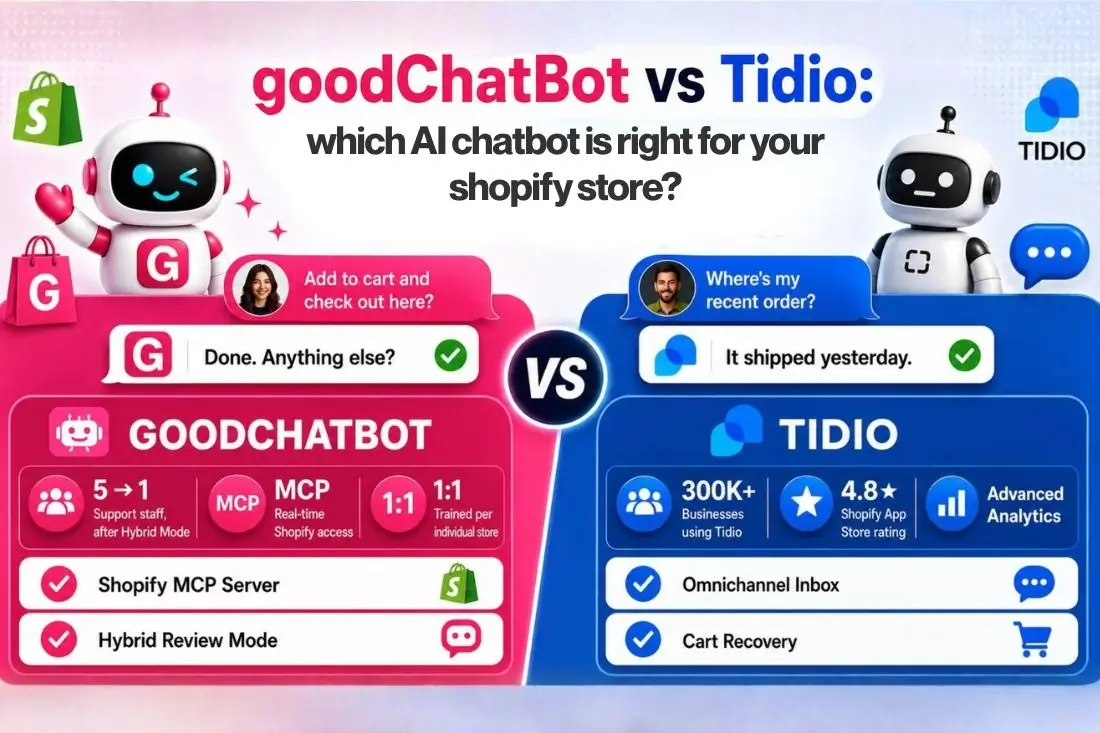
Most merchants comparing an ai chatbot for shopify start by asking which tool has more features. That's a reasonable question, but it isn't the most useful one. Two chatbots can offer a similar list of capabilities on paper while still being built around very different ideas of who they're for. The more useful question is which one is actually built for your use case, a fast, broad tool for a growing team, or a focused tool trained specifically around how your store operates.
Some tools are built to be fast and self-serve, so a small team can get one running on their own in minutes. Others are built around a managed setup, where a team configures and tests the assistant for you before it goes live. goodChatBot offers both: a quick self-serve option for teams that want to get started right away, and a managed setup for stores that would rather have it configured and tested for them.
This guide compares two well-known options in that space, goodChatBot and Tidio, across Shopify integration depth, how each AI is trained, channel coverage, and how each holds up as a store grows, to help you find the best ai chatbot for shopify for your specific situation.
Table of Contents
What Is goodChatBot?
goodChatBot is an ai chatbot for shopify stores built around two modes: a plug-and-play setup for teams that want to get started quickly, and a custom-built mode trained on data from your apps and sales channels for teams that want a deeper, more tailored assistant. In custom mode, it is trained and fine-tuned on your specific product catalog, store policies, connected apps, and past support conversations before it ever talks to a customer. It connects directly to Shopify's MCP Server, giving it real-time access to store data so it can handle product details, store policies, customer details, add to cart, checkout, and order status inside the chat window itself.
It also includes Hybrid Mode, where a human can review AI-generated replies before they go out, and a defined AI personality set up around your brand.
One goodChatBot client used this mode to reduce their support staff from five people to one. The team is also actively working on adding omnichannel support and deeper CRM integrations, expanding on what the assistant can already do.
What Is Tidio?
Tidio is a broad ai chatbot customer service platform with live chat, help desk ticketing, and an AI layer called Lyro. It is used by more than 300,000 businesses across over 200 countries, including well-known brands, and it holds a strong reputation across review platforms, including a 4.8 out of 5 rating from over 1,200 reviews on the Shopify App Store.
Tidio is actually three connected products rather than one: Customer Service, which covers live chat and help desk; Flows, a visual automation builder; and Lyro, the conversational AI agent. Merchants can combine these depending on what their store needs. Tidio supports website chat plus email, WhatsApp, Messenger, and Instagram from a single inbox, and its interface is available in English, German, French, Italian, Portuguese (Brazil), and Spanish.
goodChatBot vs Tidio at a Glance
| Criteria | goodChatBot | Tidio |
|---|---|---|
| Primary Focus | Shopify AI sales and support chatbot | Customer support, live chat, and AI agent |
| Shopify Native Integration | Yes, built around Shopify's MCP Server | Yes, native Shopify app |
| AI Sales Assistant | Yes | Partial |
| AI Customer Support | Yes | Yes |
| Knowledge Base Training | Store content, apps, website scans, FAQ, help center, contentexternal sources, and past conversations | Website scan and FAQ or help center content |
| Multichannel Support | Website, Email, WhatsApp, SMS, with more channels on the roadmap | Website, Email, WhatsApp, Messenger, Instagram, chat |
| Setup Model | Two modes: self-serve and managed custom build | Self-serve configuration |
| Continuous Training | Regular Monitoring, and Manual Support for Training & Bug Fixing | Self-serve configuration |
| Priority | Remove hallucination by training and fixing for custom workflows. | Automating the replies by using store content. |
Where the Two Tools Actually Differ
Depth of Shopify Integration
Both tools connect natively to Shopify, but the depth is different. goodChatBot is built around Shopify from the ground up, including Shopify Metafield support, cart visibility inside the admin panel, and direct access to Shopify's MCP Server for actions like add to cart, checkout, and order status. Tidio's Shopify integration is strong for a general-purpose platform, surfacing order and customer data inside the chat window, but Tidio was built to serve many platforms, not exclusively Shopify.
Also worth noting:
-
Product details and comparison: full on goodChatBot, limited on Tidio
-
Context awareness of what a customer is viewing or has in cart: full on goodChatBot, limited on Tidio
-
Order status and returns handling: supported on both
How the AI Is Trained
goodChatBot supports two modes on setup: a self-serve mode and a managed custom setup. In custom setup, a team trains the AI on your product catalog, connected Shopify apps, external content, and past support conversations, reviewing and fine-tuning responses before launch. Tidio's Lyro is trained primarily by scanning your website and importing FAQ or help center content, a process several Tidio users describe as fast and simple to set up. goodChatBot also supports this self-serve mode. Where goodChatBot's custom setup shines is for stores with a complex set of apps across different scenarios that want the chatbot to answer questions using data pulled directly from those apps.
Also worth noting:
-
External source training beyond your own site or catalog: available on goodChatBot, not on Tidio
-
Ongoing training and fine-tuning as part of training upkeep: included with goodChatBot, not offered by Tidio
-
Custom AI personality matched to your brand voice: available on goodChatBot, not on Tidio
Sales-First vs. Support-First Design
goodChatBot treats sales as a core function from the start, with product comparisons, cart actions, and checkout built into the chat window. Tidio's Lyro is capable of product recommendations and cart-related tasks, and Tidio reports that Lyro can resolve a majority of common support questions without a human agent. Even so, Tidio's core identity remains an ai support chatbot and live chat tool first, with sales features layered on top. If your main goal is converting on-site visitors through chat, that difference in origin is worth weighing. We go deeper into these sales-oriented capabilities, including cart visibility and product comparison logic, in our earlier post on the best Shopify AI chatbot features to look for.
Also worth noting:
-
Custom AI workflow logic built around specific sales scenarios: full on goodChatBot, limited on Tidio
-
Cart recovery: built into goodChatBot's flow, handled through Tidio's separate automation builder
-
Cart actions and admin-side cart visibility: supported on both
Channel Coverage
This is where Tidio has a real structural advantage as a chatbot for ecommerce website teams managing more than just their Shopify storefront. It unifies website chat, email, WhatsApp, Messenger, and Instagram in one inbox, which matters for a support team already managing multiple channels. goodChatBot is, as of now, website-focused, with WhatsApp, email, and SMS integrations on its roadmap rather than a built-in omnichannel inbox today. For a store that only needs strong on-site chat, this is not a downside. For a store that lives across Instagram DMs and WhatsApp as much as its website, Tidio's model fits more naturally out of the box for now.
Also worth noting:
-
Multilingual support: available on both
-
Integration with tools like email, SMS, or WhatsApp: available on Tidio, on the roadmap for goodChatBot
-
Chat summaries and customer history: available on both
Setup Model: Managed Build vs Self-Serve Configuration
goodChatBot's setup is a guided, managed process. A team trains and fine-tunes the assistant on your store's specific data before it goes live, then continues monitoring performance and cleaning up store content it references. Tidio's setup is designed to be self-serve, letting merchants configure Flows, connect channels, and point Lyro at their own website or help center without a dedicated build process on Tidio's side. goodChatBot also offers a similar self-serve model for teams that want that same kind of independence.
Neither approach is wrong. A managed build suits a store that wants a fully customized assistant without handling the configuration itself. A self-serve setup suits a store that wants to configure things independently and get started quickly.
Also worth noting:
-
No-code setup and manual mode for human-led replies: available on both
-
Human agent handoff: available on both
-
Admin notifications and ongoing issue monitoring and re-training: included with goodChatBot, not offered by Tidio
-
No visible branding: available on both, though removing branding is a paid add-on on Tidio's entry-level plans
Tidio's Strengths and Where It Starts to Show Limits
As an ecommerce ai chatbot, Tidio is generally a strong option for small and medium online stores. Its setup is fast, its free plan gives new merchants a real way to try live chat and basic automation before paying anything, and its built-in AI can be running within a short setup window. For a small team handling a manageable volume of conversations, this combination is genuinely convenient.
There are two places where Tidio tends to show it's limit.
First is hallucination. Like all self-serve and plug-and-play ChatBot, Tidio can show the wrong or weird responses which can frustrate the customers.
Second, is when it operates at larger scale.
Reporting on entry-level plans is fairly basic compared to what a larger support team may need for deeper performance visibility, with more advanced analytics reserved for higher tiers. Conversation volume is also capped by plan, which can feel restrictive once a store's chat volume grows past what a given tier allows. As usage scales up across live chat, automation, and AI conversations together, the overall cost of running Tidio tends to climb accordingly, since these are managed as separate components rather than one bundled system. None of this makes Tidio a poor choice, but it does mean the experience that works well for a small or medium store does not always stretch cleanly to a larger one.
goodChatBot's Strengths and Where It Starts to Show Limits
goodChatBot's biggest strength is depth and accuracy of responses.
A managed build trained specifically on one store's catalog, policies, support history, and external data like past email conversations, combined with direct Shopify MCP Server access for real actions like cart and checkout, is hard to replicate with a self-serve tool. For a store with a complex or technical catalog, that level of customization tends to pay off.
This leaves no chances for hallucination and wrong responses. Regular monitoring and data training also helps in weeding out all bad responses.
That same depth comes with real tradeoffs. goodChatBot was built for Shopify, with integration for WhatsApp, Emails, SMS and other channels in pipeline. But this is not a full fledged CRM tool, nor it can be integrated with other platforms like WordPress. So a business running a different platform, or one that wants a single tool across several platforms, would need to look elsewhere.
None of this makes goodChatBot the wrong choice. It means the fit is narrower and more specific: built for Shopify stores that want deep, custom AI sales and support in one place, not for teams that need broad platform or channel flexibility from day one.
Who Should Choose goodChatBot
goodChatBot fits Shopify stores that want a best chatbot for shopify built specifically around their own product catalog, with AI sales and support combined in one assistant instead of assembled from separate tools. It suits stores with technical or comparison-heavy catalogs that need real product explanation, such as fitment-based or specification-driven products, and stores that prefer a managed setup process over configuring everything themselves as they grow.
Who Should Choose Tidio
Tidio fits small and medium businesses that want an ai chatbot for business use without a large commitment, with an easy, self-serve setup and a free plan to start testing live chat and AI. It is a strong fit for stores that want one platform to manage support across many channels, including WhatsApp, Instagram, Messenger, and email. It is worth reassessing as a store scales, given the reporting and conversation-volume limits that tend to show up for larger teams.
Conclusion
Tidio and goodChatBot solve overlapping but distinct problems. Tidio is a well-established ai support chatbot platform that works especially well for small and medium stores that want broad channel coverage and a self-serve setup they can configure themselves. goodChatBot, developed by Automatikly is a shopify chatbot integration built around one thing: a custom AI assistant trained specifically on your store that treats sales and support as a single job, and is designed to hold up as a store's needs grow.
Neither tool is the universal right answer. The right choice depends on how many channels you need to cover, how much your catalog benefits from a deeply trained assistant, and how much room you expect to need as your store scales. See how a custom-trained assistant would work on your own store. Contact us and we will walk you through it.
Frequently Asked Questions
Does goodChatBot work outside Shopify?
No. goodChatBot is built specifically around Shopify's platform, product data, and MCP Server, so it is designed for Shopify and Shopify Plus merchants rather than general websites.
Does Tidio work with Shopify?
Yes. Tidio has a native Shopify integration that displays order and customer data inside the chat window, alongside its broader live chat and multichannel messaging features.
Does either goodChatBot or Tidio offer a free plan?
Yes. Both goodChatBot and Tidio offer a free plan to get started, alongside their paid tiers for teams that need more.
Can Tidio's AI handle product recommendations like goodChatBot?
Tidio's Lyro AI can make product recommendations and handle cart-related questions, and it is trained by scanning your website and FAQ content. goodChatBot is trained on your product catalog, connected apps, and past support conversations specifically to strengthen product-level accuracy.
Is Tidio a good fit for a growing or larger Shopify store?
Tidio works well for small and medium stores getting started with live chat and AI. Larger teams may find its reporting depth and conversation limits more restrictive as support volume grows, which is worth planning for if you expect fast growth.
Is goodChatBot a good fit if I already use Tidio for support?
Some stores use Tidio for general multichannel support while looking for a more specialized, deeply trained AI assistant specifically for product discovery and sales on their Shopify storefront. Whether it makes sense to run both depends on your support volume and how much of your traffic needs product-specific guidance versus general customer service.
References
-
1. Shopify App Store, Tidio Live Chat and AI Chatbot listing, ratings and feature details: https://apps.shopify.com/tidio-chat
-
2. Tidio.com, FAQ and company information pages: https://www.tidio.com/faq/
-
3. goodchatbot.com, Product and Features pages: https://goodchatbot.com/
-
4. G2, Tidio company profile and user reviews: https://www.g2.com/products/tidio/reviews