How goodChatBot Helps MegaChess Recommend the Right Chess Set
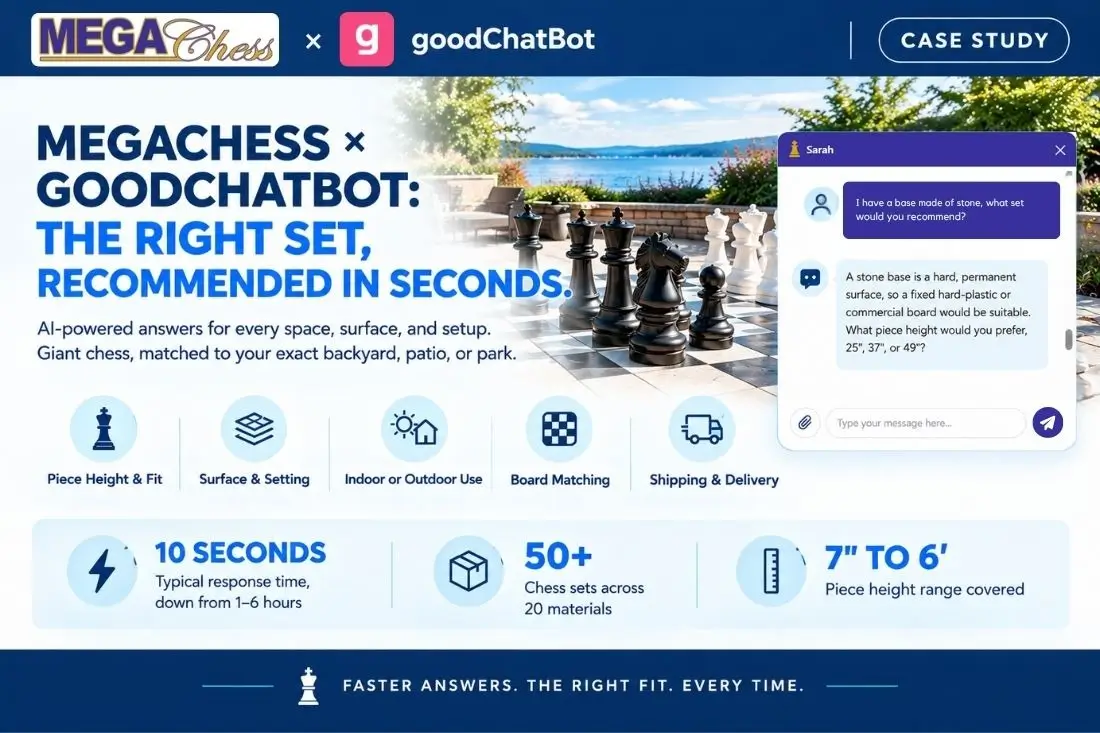
Table of Contents
Every purchase on the MegaChess online store starts with a question about the buyer's own setting. Shoppers do not simply want "a big chess set." They want to know which piece height suits their space, which board works on their floor or lawn, whether the set can live outdoors year round, and whether the pieces they already own will fit the board they are looking at.
Those are recommendation questions, not FAQ questions, and until recently, these questions had to be answered by the MegaChess team. As an AI chatbot for MegaChess, goodChatBot went live on the MegaChess Shopify store recently and now answers any such questions in real time, using MegaChess's own product data and store policies to match each shopper with the right set and board.
Why giant chess needs a shopping concierge
MegaChess is a family-run business based in Irving, Texas, and a strong example of what a Shopify AI chatbot can do for a store with a genuinely complex catalog. The company has specialized in giant chess sets, boards, checkers, and accessories since 2002. Its catalog includes more than 50 chess sets in 20 different materials, with pieces ranging from seven inches to six feet tall. Its sets are used in backyards, resorts, hotels, cruise ships, shopping malls, parks, housing developments, and thousands of schools and universities.
That range is the store's strength, but it also makes choosing difficult. Piece height, board type, square size, and surface all have to work together. A set that suits a tabletop does not suit a courtyard, and a board that works on a lawn is not the right choice for a stone patio. Most shoppers need someone to walk them through it.
Before goodChatBot: good advice, slow replies
MegaChess has always given shoppers personal recommendations. The problem was speed. Each question about space, surface, or compatibility had to be read, researched, and answered manually, and replies could take anywhere from one to six hours, depending on when a staff member was available.
For a shopper comparing options in the evening or on a weekend, tFor a shopper comparing options in the evening or on a weekend, that delay could mean waiting until the next working day for an answer, exactly the kind of gap a chatbot for an ecommerce website is built to close. For a family run team, it meant time taken away from everything else the business needed.
After goodChatBot: answers in seconds, at any hour
As a form of 24/7 AI customer support, goodChatBot now answers those same recommendation questions directly, typically within 10 seconds, using MegaChess's product catalog and store knowledge rather than generic chess advice.
Example: matching pieces to an existing board
-
Customer: trying to decide chess set pieces to fit on a board that has 4 inch squares
-
goodChatBot: A 4-inch-square board is compatible with the store's 8-inch sets; I'll check the available options and prices
-
goodChatBot: For a board with 4-inch squares, the best fit is an 8-inch chess set. The pieces have bases up to 3.75 inches, so they fit comfortably.
The chatbot then recommended three options, each with a price and product card:
-
MegaChess Plastic 8-Inch Giant Chess Set: $64.95 with vinyl mat, or $99.00 with quick-fold nylon mat. King height 8.25 inches.
-
Quick-Fold Nylon Mat with 4-Inch Squares: $34.00, 35 x 35 inches, board only, for shoppers who already own pieces.
-
8-Inch Polish Birch Giant Chess Set: $899.00, a premium alternative with a handcrafted folding board.
The question arrived at 9:12 pm on a Saturday. The chatbot confirmed the fit five seconds later, and the full recommendation, with three products, prices, and specifications, arrived nine seconds after the question was asked. Before goodChatBot, that shopper could have been waiting until Monday for a detailed recommendation.
The MegaChess team has not been removed from the process, and that's a deliberate part of how conversational AI for ecommerce works best here. Staff can still review any conversation in the goodChatBot Inbox and reply personally whenever they feel an answer needs more detail or a correction. The difference is that they now step in by choice rather than out of necessity, and the time they used to spend on routine recommendations goes back into running the business
The setup behind MegaChess's chatbot
1. Product catalog and Shopify Knowledge Base integration
As an AI chatbot for Shopify, goodChatBot works from MegaChess's own catalog data, including piece heights, board sizes, square sizes, materials, and prices, so every recommendation points to real products that are available in the store. The Shopify Knowledge Base integration brings MegaChess's FAQ content into the chatbot's answers, covering shipping, returns, international orders, and other store policies without routing the shopper to a separate support channel. For more on the capabilities behind setups like this one, see our full breakdown of what makes a Shopify AI chatbot actually effective.
2. Klaviyo integration, built on request
MegaChess uses Klaviyo for email and SMS marketing, and requested for chatbot conversations feed directly into it. As an ecommerce AI chatbot, goodChatBot now updates Klaviyo automatically for any logged in or known customer. Setup only requires adding a Klaviyo API key with the right scopes on the goodChatBot integrations page.
For every store, the integration syncs these profile properties:
| Information sent to Klaviyo | Purpose |
|---|---|
| Customer details | Name and email |
| Chatbot customer status | Whether the customer was acquired through goodChatBot |
| Conversation link | Opens the conversation in goodChatBot |
| Source | Identifies goodChatBot as the source |
| AI marketing summary | Summarizes what the shopper is looking for |
For MegaChess, the integration was extended with store specific properties:
-
Set size the shopper is considering
-
Budget
-
Products they showed interest in
-
Intended use
-
Organization, if any
That means a school, a resort, or a homeowner who chats with the bot arrives in Klaviyo already segmented by what they want, what they can spend, and who they are buying for, the kind of groundwork an AI sales assistant for ecommerce is meant to lay. MegaChess can follow up with relevant emails instead of generic campaigns, and the conversation link lets the team see exactly what was discussed.
Built in features that handle the hard cases
Recommendations based on where the set will live
As an AI shopping assistant, goodChatBot does not just list products that match a size. It asks about the setting and adjusts its recommendation to the surface the set will stand on.
-
Customer: i have base made of stone
-
goodChatBot: A stone base is a hard, permanent surface, so a fixed hard-plastic or commercial board would be suitable. To recommend the right complete setup, what piece height would you prefer: 25", 37", or 49"?
-
Customer: 37"
-
goodChatBot: For your stone base, I recommend this complete setup: MegaChess 37 Inch Plastic Giant Chess Set with Plastic Board, $1,159. Includes 32 plastic chess pieces, ranging up to 37 inches tall. Includes a hard plastic board with approximately 14 3/4-inch squares. Suitable for permanent placement on hard surfaces such as stone, concrete, and pavers.
The chatbot also noted that the pieces can later be adjusted down to 25 inches or up to 49 inches using compatible inserts. The shopper got a surface-appropriate recommendation plus a detail that makes the purchase more flexible, without waiting for a staff reply.
Smart human handoff
In the same conversation, the shopper was writing from Saudi Arabia and asked whether MegaChess could deliver there. International shipping is quoted case by case, so this is a request the bot should not try to settle on its own.
-
Customer: i would like to know can you deliver your product in saudi arabia
-
goodChatBot: Yes, delivery to Saudi Arabia may be available. International shipping is quoted case by case and can include door-to-door air transportation; import taxes, duties, fees, and brokerage costs are additional. I've logged your request for a Saudi Arabia shipping quote. A support team member will follow up by email.
Within seconds of the question, goodChatBot had logged a human handoff in the Inbox with the shopper's email and the issue already filled in: an international shipping quote request for Saudi Arabia.
The conversation then continued. The chatbot recommended a set, confirmed that the $1,159 price covered the product only and not delivery, and logged a request for a formal quotation. When the shopper said they only needed the pieces, it updated the request accordingly.
-
Customer: only chess set i dont need board
-
goodChatBot: Understood, you need only the 37-inch chess pieces, without a board. MegaChess 37 Inch Plastic Giant Chess Set, $869. Includes 32 pieces: 16 black and 16 white. Board is not included. Delivery to Saudi Arabia is quoted separately; import duties and taxes may also apply.
When the shopper then asked about paying by bank transfer, the chatbot did not guess.
-
Customer: one thing more payment TT/bank transfer is acceptable or not
-
goodChatBot: I couldn't confirm from the available store information whether TT/bank transfer is accepted. Please mention this payment question in your quotation request; the sales team can confirm the available payment methods for your Saudi Arabia order.
By the time a team member opened the conversation, they had the shopper's contact details, the exact product, the decision to exclude the board, the destination country, and the open payment question. The shopper's own verdict before signing off: "It was a great experience."
A chatbot that learns from the team's corrections
goodChatBot includes a feedback loop that lets MegaChess shape its answers over time. If an admin is not satisfied with a response, they can downvote it in the Inbox and write the answer they would prefer. The correction is added to goodChatBot's knowledge so it can inform future answers to similar questions.
This matters for a store like MegaChess, where the family has decades of product knowledge that no catalog fully captures. Every correction becomes part of how the chatbot answers the next shopper, so the bot keeps getting closer to how the family itself would respond.
Challenges we solved during setup
Recommendations that depend on the setting
Buying a giant chess set is usually a considered purchase rather than an impulse decision. When a shopper arrives, the challenge is to understand where the set will be used, what size they need, and which board and pieces will work together. A giant chess set is not a one-size-fits-all purchase. The right combination depends on:
-
the available space
-
the surface underneath (stone, concrete, pavers, or lawn)
-
whether the set stays in one place or moves between events
-
indoor or outdoor use
-
the weather it will face
-
the look of the setting
-
intended use - home, school, resort, shopping mall, event, or another commercial setting
As a chatbot for business with a technical, high-variable catalog, goodChatBot was configured to ask about these conditions and match piece height, board type, and square size to them, instead of listing the whole catalog.
Matching Board or matching Set
One of MegaChess's most important requirements was that goodChatBot should be able to work in both directions: recommend the right board when a shopper has selected a chess set, or recommend the right chess set when the shopper already has a board.
The recommendation depends on factors such as available space, surface, portability, intended setting, piece dimensions, and square size. At the same time, MegaChess did not want shoppers overwhelmed with too many options.
The goodChatBot team created test scenarios covering these combinations and repeatedly tested the recommendations before launch. It is similar to the challenge in our Trail Armor implementation, where identifying the compatible product matters more than simply listing search results.
Knowing when a person should take over
Some requests need a human decision: custom or personalized orders, bulk, school, and purchase order requests, international shipping quotes, existing orders, returns, repairs, and freight or damage issues. For these, goodChatBot collects the shopper's details and the request, logs it for the MegaChess team, and tells the shopper what happens next. For MegaChess, goodChatBot is configured not to approve refunds, returns, or discounts on its own, so the family keeps control of every decision that affects money or policy.
MegaChess had previously tried another AI chatbot but stopped using it because the bot sometimes produced unreliable answers in edge cases. This made knowing when to involve a human an especially important requirement for the goodChatBot implementation. When goodChatBot cannot confidently answer from the available store information, it is configured to hand the conversation to the MegaChess team rather than invent an answer.
Final thoughts
MegaChess is only days into its launch, so this case study is about the foundation rather than the results. That foundation is already visible in the conversations: recommendations that used to take hours now arrive in seconds, at any hour of the day, with the shopper's space and surface taken into account. Requests that need a person reach the team with the details already collected, and every conversation with a known customer feeds straight into Klaviyo with a clear picture of what they want.
For a family business with a large and technical catalog, that combination gives shoppers faster, more confident answers while giving the team back the time it used to spend answering the same questions by hand. We will share results as the data comes in.
Does your Shopify store require customers to choose between complex products, specifications, sizes, or configurations? goodChatBot can be trained around your catalog, business rules, apps, and support workflows.
Talk to our team to see how it could work for your store.
Frequently Asked Questions
How Does goodChatBot Help MegaChess?
It acts as a shopping concierge on the MegaChess Shopify store. It recommends chess sets and boards based on each shopper's space, surface, and intended use, answers store policy questions, and hands off requests that need a person, such as international shipping quotes, to the MegaChess team with the details already collected.
How fast does the MegaChess chatbot respond?
goodChatBot typically answers within 10 seconds. Before launch, manual replies took between one and six hours depending on staff availability. In one real conversation, the chatbot confirmed the fit in five seconds and delivered a full recommendation with three products and prices nine seconds after the question was asked.
What integrations power the MegaChess chatbot?
As an ecommerce AI chatbot, the setup uses MegaChess's product catalog, the Shopify Knowledge Base integration for store policies and FAQs, and a Klaviyo integration that was added at MegaChess's request.
How does the Klaviyo integration work?
For any logged in or known customer, goodChatBot automatically updates their Klaviyo profile with their contact details, whether they were acquired through or chatted with the bot, a link to the conversation, and a short marketing summary of their buying situation. For MegaChess, it also records set size, budget, products of interest, intended use, and organization. Setup only requires a Klaviyo API key with the right scopes.
What happens when the chatbot cannot fully answer a question?
goodChatBot does not guess. It tells the shopper what it could not confirm, logs the request with their details for the MegaChess team, and explains that a team member will follow up. Staff can also step into any conversation and reply personally.
Does the chatbot improve over time?
Yes. If a MegaChess admin downvotes a response, they can write an updated answer, and goodChatBot uses that correction for similar questions in future conversations.