How goodChatBot's Year Make Model Integration Helps Shoppers Find the Right Fit
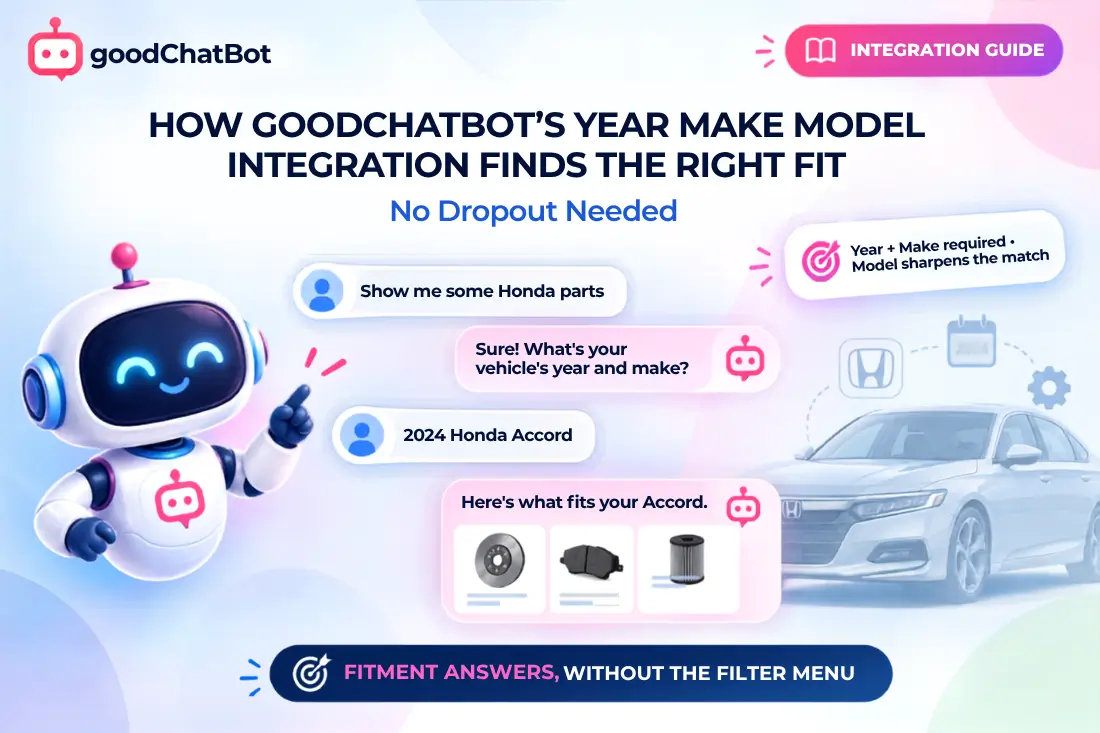
Table of Contents
A shopper types a brand name into a search bar and gets three hundred results back. None of them are wrong, exactly. The store just has no idea which one actually fits what this specific person owns. Multiply that moment across every visitor to a fitment-based store, and it's easy to see why so many sales quietly disappear before checkout.
goodChatBot's Year Make Model integration, or YMM, solves this problem. This article looks at what YMM actually means, how goodChatBot puts it to work inside a live conversation, what the data says about why fitment accuracy matters this much, a real example from one of our clients, and the honest limits of what fitment data alone can do for an AI chatbot.
What Is Year Make Model (YMM) Fitment?
Year, Make, and Model. Three details. Together they describe exactly what a product needs to work with: when it was made, who made it, and which specific version it is.
It's a genuinely useful shortcut, but it isn't the whole story. Some products need more than YMM alone, body style, trim, engine, drivetrain. Treat YMM as a strong first filter, not a guarantee. This is exactly the kind of context an AI shopping assistant needs to work with, and it's what turns a basic AI chatbot for shopify into one that actually understands what it's selling
Why Fitment Accuracy Is a Bigger Problem Than Most Stores Realize?
Fitment isn't a minor detail buried in a product description. In fitment-driven categories, it's the single biggest driver of lost sales and returns, and the data backs that up clearly.
YMM fitment applies well beyond cars and trucks: powersports, motorcycle parts, printer supplies, electronics and appliance components, and marine or heavy machinery parts all depend on the same year/make/model logic.
Auto parts return rates online run between 20% and 35%, notably higher than typical ecommerce categories, according to industry reporting from VinSnap. Multiple industry sources, including ServeRetail's analysis of automotive customer experience, cite fitment and compatibility errors as the leading cause, with inaccurate fitment information responsible for as much as 86% of returns in some segments. The root cause isn't product quality. It's that two similar-looking products can need completely different parts underneath, whether that's two vehicle trims, two printer models, or two versions of the same machine.
This isn't a shrinking problem either. Grand View Research values the global ecommerce automotive aftermarket at $62.1 billion in 2023, with a projected climb to $208.2 billion by 2030. As more of this buying moves online, the number of shoppers running into "will this fit?" problems grows right along with it.
That's the gap an ecommerce ai chatbot built around real fitment data is meant to close, not by guessing better, but by asking the right question before a shopper commits to buying.
How Does goodChatBot's YMM Integration Work?
Three stages, none of them complicated.
The data goes in first - A merchant exports a YMM fitment CSV from the YMM app they're already using, such as C: Year Make Model Search, and uploads it through goodChatBot's Shopify integrations section.
That file gets folded straight into goodChatBot's knowledge base, ready for compatibility lookups from that point forward.
Then the conversation does the work - When a shopper asks something fitment-related, goodChatBot asks back for two things, Year and Make. Both required. Model is optional, but offering it sharpens everything that follows.
And the results come back inside the chat - Once goodChatBot has enough to go on, it hands over the matching product, its price, the available variants, and a direct link, without the shopper ever needing to leave the conversation.
Call it what it is: a real shopify chatbot integration built around compatibility, not a script stapled onto a search bar.
What Does a YMM Conversation Look Like in goodChatBot?
Here's the exchange in practice:
Customer > Show me some Honda products.
goodChatBot > Sure! Please provide your vehicle year and make. The model is optional.
Customer > 2024 Honda
goodChatBot > Based on your 2024 Honda, here are the available compatible products.
Add the model, and the results get even sharper:
Customer > 2024 Honda Accord
goodChatBot > Here are the specific products available for your 2024 Honda Accord.
That's the entire mechanic. Year and Make earn you a solid answer. Model earns you a precise one.
Can goodChatBot Handle Ambiguous Fitment Questions?
Sometimes what a shopper hands over just isn't enough on its own. In one of our client implementations, AutoHeatShield, a shopper entered a 2026 Mercedes GLC 300 4Matic. That same model line ships in two different body styles, coupe and standard SUV, and rather than pick one and hope, goodChatBot simply asked which one before recommending anything.
That's a better story than "the AI is accurate." Accuracy isn't the point. Knowing when to stop and ask is.
Can goodChatBot Handle Multiple Fitment Requests at Once?
Fitment questions rarely arrive one at a time in the real world. In that same implementation, a shopper needed windshield shades for two vehicles in a single conversation, a 2021 Ford F-150 and a 2023 Kia Soul. goodChatBot worked through both, surfaced pricing for each, and even checked whether the Kia Soul had a windshield-mounted sensor before locking in the correct variant.
One lookup per conversation was never the ceiling. goodChatBot tracks more than one item at a time and still asks the right question for each.
How Does YMM Improve AI Product Recommendations?
There's a wide gap between a generic recommendation and a fitment-aware one. Generic AI recommendations sound like "here are some popular options." Fitment-aware ones sound like "here's the one that actually fits what you told me."
That said, YMM isn't a magic accuracy switch. It doesn't make every recommendation better in every case. What it does is give the chatbot real context to reason from, which makes the recommendation more relevant whenever the uploaded data actually supports the lookup. Our earlier post on the best Shopify AI chatbot features to look for goes deeper into this same recommendation logic.
Can a YMM-Enabled AI Chatbot Help With Customer Service?
Fitment isn't only a sales problem. Will this fit what I have is a support question just as often, the kind that would normally send a shopper hunting through the catalog, comparing listings, or sitting in a support queue. As a chatbot for customer service, goodChatBot answers that same question without ever leaving the conversation.
It doesn't stop there either. In the AutoHeatShield implementation, goodChatBot has explained when a product simply isn't available, pointed to the closest alternative, and handed things off to a real person the moment a shopper needed more than the catalog alone could offer.
goodChatBot, Built for Fitment-Driven Shopify Stores
If your store lives or dies on whether a shopper gets the right part for the right vehicle, machine, or piece of equipment, whether that's automotive, powersports, marine, or heavy machinery, generic chatbot logic isn't built for you.
goodChatBot connects directly to your Shopify store data, including your uploaded YMM fitment file, so when a shopper describes what they own, it checks against your actual catalog instead of guessing from a product title.
As a store owner, you get full visibility into every conversation, the ability to review AI replies before they go out, and a chatbot that gets sharper over time as it learns from real interactions on your store. Built after working with 1,000 Shopify stores, with a reported 86% improvement in conversion.
This isn't theoretical. Two Shopify stores are already running this exact YMM behavior in production. AutoHeatShield sells custom-fit windshield sunshades, and Trail Armor sells vehicle-specific UTV accessories across seven vehicle brands, in both businesses, the fit isn't a nice-to-have, it's the entire sale. See how in our AutoHeatShield case study and our Trail Armor case study. If you're weighing chatbot options more broadly, our comparison of goodChatBot vs Tidio covers how a custom-trained assistant like this stacks up against a broader live-chat platform.
What's the Difference Between YMM Filters and a Conversational Chatbot?
Most fitment tools on Shopify still run on a dropdown or a filter. A shopper picks their vehicle from a menu, and the catalog narrows down accordingly. It works, as long as the shopper actually finds the widget and uses it the way it was designed to be used.
A conversational approach skips that step entirely. There's no selector to hunt for. The shopper just says what they need, and the chatbot asks for whatever's still missing.
| Traditional YMM Filtering | Conversational YMM |
|---|---|
| Shopper picks a vehicle from a menu | Shopper describes what they need |
| Vehicle selector or filter widget | Back-and-forth conversation |
| Catalog gets narrowed | Chatbot points straight to relevant products |
| Focused only on fitment | Can mix fitment with other product questions |
| Shopper browses the narrowed list | Chatbot hands over info and a direct link |
None of this means a chatbot replaces a storefront fitment selector outright. They're two different ways of solving the same problem, and plenty of stores are better off keeping both.
What Can't a YMM Integration Do Well?
Honesty about limitations matters here as much as anywhere else.
YMM alone can't catch everything. As covered above, some products depend on body style, engine, trim, or drivetrain, details that sit underneath basic Year, Make, and Model. When one of those details actually matters, goodChatBot asks rather than assumes, exactly what played out in the Mercedes GLC example earlier. No fitment system, conversational or not, replaces complete, well-maintained product data.
It's only as good as the data behind it. A YMM integration is a lookup tool, not a data-generation tool. If the uploaded fitment CSV is incomplete or out of date, the chatbot's answers will reflect that. Fitment data needs the same ongoing upkeep as any other part of a catalog, new model years,
goodChatBot's YMM Integration: The Takeaway
Fitment errors aren't a rounding error in ecommerce, they're one of the biggest, most avoidable reasons a sale falls apart. YMM data gives a store the information it needs to answer "will this fit?" correctly. goodChatBot, engineered by the automation specialists at Automatikly, turns that data into a conversation, fitment details in, a compatibility check, a relevant recommendation, and a shopper walking away with the right product instead of a guess.
If getting fitment right matters for your store, contact us and see how goodChatBot's Year Make Model integration would work for your catalog.
Frequently Asked Questions
What does YMM stand for?
Year, Make, and Model, the three details used to match a product to what a shopper owns.
What is YMM fitment?
A way of connecting products to whatever they're compatible with, usually built on Year, Make, and Model together.
How does goodChatBot's YMM integration work?
A merchant uploads a YMM fitment CSV through goodChatBot's Shopify integrations section, and that data powers compatibility lookups for every conversation after that.
Is the Model required in goodChatBot's YMM integration?
No. Year and Make are required. Model is optional, though adding it narrows the results further.
Can goodChatBot recommend products based on fitment data?
Yes, whenever the uploaded data supports the lookup. The AutoHeatShield example shows exactly this kind of fitment-based matching in action.
Can goodChatBot handle ambiguous fitment information?
Yes. When what a shopper provides isn't specific enough, goodChatBot asks a clarifying question instead of guessing.
Can YMM help customer service as well as sales?
Yes. Fitment questions are support questions too, and answering them inside the chat means a shopper never has to search the catalog or contact support separately.
Is YMM enough for every fitment-based product?
No. Some products need more than Year, Make, and Model, which is exactly why goodChatBot asks a follow-up question when that extra detail matters.
Can an AI chatbot help shoppers find products and pricing?
Yes. Alongside a compatible product match, goodChatBot shares the price and available variants right in the same conversation, so a shopper gets the fit and the cost together.
Why do so many auto parts returns happen because of fitment errors?
Because two vehicles can look identical from the outside while needing completely different parts underneath. Without a reliable way to verify Year, Make, and Model, or the specific detail that distinguishes similar vehicles, shoppers are left guessing, and guesses turn into returns.
References
-
1. VinSnap. Industry estimates on auto parts return rates and fitment errors: https://vinsnap.net/parts-returns-report
-
2. ServeRetail. Auto Parts Return Rate: Why It's High and How to Fix It: https://www.serveretail.com/blog/cx/auto-parts-return-rate-how-to-reduce-it/
-
3. Grand View Research, via Uncap. Ecommerce automotive aftermarket market sizing: https://www.uncap.com/post/aftermarket-auto-parts-ecommerce
-
4. goodchatbot.com, Product and Features pages: https://goodchatbot.com/
-
5. Case Study: How goodChatBot Helped AutoHeatShield Improve Orders, Sales, and Support Efficiency: https://goodchatbot.com/blog/case-study-goodchatbot-autoheatshield-shopify-store
-
6. goodChatBot Help Documentation, YMM Integration section